Roadmap
SPECTRAX-GK is being developed as a research-grade, JAX-native gyrokinetic solver: accurate against independent benchmarks, differentiable end to end, fast enough for scoped production studies, and simple enough for researchers to run, test, and extend.
Current target
The active milestone is not just “more features”. The release target is a validated codebase with:
documented install, run, plot, and artifact workflows;
literature-anchored physics gates for linear, nonlinear, response-function, geometry, and autodiff examples;
measured cold-start, warm-runtime, memory, and parallelization behavior;
CI gates that cover unit tests, regression tests, docs, packaging, and selected validation artifacts;
clear module boundaries so equations, numerics, runtime I/O, plotting, and benchmark policy can be tested independently.
The roadmap is not itself a claim ledger. Use Release Scope and Claim Boundaries for the current artifact-backed boundary between release-ready, deferred, and explicitly unpromoted claims.
Pre-release scope
The pre-release lane is limited to work that can be bounded, tested, and documented without changing the physics claim surface:
keep the refreshed runtime/memory panel complete for Cyclone, Cyclone Miller, KBM, W7-X, and HSX release rows;
tighten case-specific nonlinear window-statistics gates where the frozen reference windows support it;
strengthen autodiff validation with finite-difference checks, sensitivity map conditioning, and UQ covariance metadata;
add the Phase-A
vmec_jax/booz_xform_jaxbridge contract into the existing sampled flux-tube geometry interface;land production parallelization first for independent
k_yscans and UQ ensembles, with serial numerical-identity gates. The first closed artifact isdocs/_static/parallel_ky_scan_gate.pngfromtools/generate_parallel_ky_scan_gate.py;keep nonlinear hot-path optimization profiling-driven and tied to existing window-statistics and exact-state gates.
Current pre-release status snapshot:
Release-ready technical lanes are those backed by tracked CI, documentation, refactor, parallelization, profiler, and guardrail artifacts; remaining manuscript physics lanes are tracked separately and must not be counted as shipped claims.
runtime/memory and nonlinear atlas figures include W7-X and HSX release rows;
the large runtime/diagnostics refactor has a release-engineering boundary: extracted startup/chunk/result/artifact helpers and validation-policy modules preserve public behavior, including restartable NetCDF append schema, but do not by themselves promote new physics or speedup claims;
targeted nonlinear coverage now exercises explicit diagnostic branches, Hermitian projection, fixed-mode frequency extraction, IMEX nonlinear terms, and scalar/gyroaveraged electromagnetic bracket components;
autodiff UQ validation includes finite-difference demo checks, closed-form Gauss-Newton covariance checks, rank-deficient sensitivity-map checks, and an explicit rejection path for empty parameter maps;
solver-objective geometry-gradient validation now includes an actual electrostatic linear-RHS implicit-eigenpair gate for growth rate, real frequency,
<k_perp^2>, linear heat/particle-flux weights, and a mixing-length heat-flux proxy with respect to solver-ready geometry arrays, plus a mode-21 full-chainvmec_jaxstate-coefficient tobooz_xform_jaxto SPECTRAX-GK eigenfrequency-gradient artifact atdocs/_static/vmec_boozer_solver_frequency_gradient_gate.pngand a matching quasilinear heat-flux-weight gradient artifact atdocs/_static/vmec_boozer_quasilinear_gradient_gate.png, plus a bounded reduced nonlinear-window estimator-gradient artifacts for QH and Li383 atdocs/_static/vmec_boozer_nonlinear_window_gradient_gate.pnganddocs/_static/vmec_boozer_li383_nonlinear_window_gradient_gate.png; the companion compact nonlinear startup-window finite-difference observable audit atdocs/_static/nonlinear_window_fd_audit.png/.jsoncloses only the startup-response plumbing and conditioning path; the companion VMEC/Boozer-perturbed nonlinear startup-window FD audit atdocs/_static/vmec_boozer_nonlinear_window_fd_audit.png/.jsonstarts from a real mode-21vmec_jax -> booz_xform_jaxstate perturbation and closes the imported-geometry startup observable path while recording that the local forward/backward response is asymmetric. Both short FD artifacts explicitly keep their transport-average gates false; VMEC/Boozer nonlinear turbulence gradients, long post-transient running-average heat-flux windows, and optimized-equilibrium nonlinear audits remain promotion requirements;the Phase-A differentiable-geometry bridge is an in-memory sampled flux-tube contract with 100% targeted coverage, optional
vmec_jax/booz_xform_jaxdiscovery, tracer-safe mapping intoFluxTubeGeometryData, realvmec_jaxmetric-tensor derivatives, a real non-axisymmetric VMEC field-line tensor derivative throughvmec_jax.geomplusvmec_jax.vmec_bcovar, a direct VMEC tensor-derived flux-tube mapping derivative, a direct-VMEC-tensor vs imported-VMEC/EIK array-parity audit, a Boozer equal-arc core parity audit that closes thebmag/bgrad/gradpar/Jacobian, zero-betagds*/grhometric convention, and zero-beta loaded drift convention at release tolerance, a separatemboz=nboz=21QH/QI/tokamak parity matrix artifact atdocs/_static/vmec_boozer_parity_matrix.png, a realvmec_jaxVMECStatetobooz_xform_jaxto SPECTRAX-GK derivative gate, and a tracked AD-vs-finite-difference inverse/UQ artifact atdocs/_static/differentiable_geometry_bridge.png;the fixed-resolution QI row in the parity matrix is admitted only at
mboz=nboz=21after low-mode Boozer settings are rejected; after the Boozer half-mesh convention fix, the current regenerated artifact passes QI drift at about7.13e-2against the8e-2tolerance and the evaluated QIntheta=8,16variants pass. The full QI seed campaign remains artifact-limited by missing bundledwoutreferences and is not broad QI transport validation, quasilinear calibration, or nonlinear optimization;production parallelization is currently claimed only for independent
k_y/batch/quasilinear/sensitivity/UQ-style workloads, including the runtime scan[parallel] strategy = "batch"path for independentk_yscans. Solver-layout sharding paths remain diagnostic or communication-gated, not production nonlinear domain decomposition;release-level performance evidence is closed with the refreshed runtime/memory panel, CPU/GPU nonlinear RHS split profiles, fused full-RHS traces, W7-X/HSX runtime-mode stellarator profiles, and the nonlinear sharding identity gate. This supports bounded profiler claims only; broad production nonlinear speedup and nonlinear domain-decomposition claims remain future profiler-gated work.
Executable open-lane status
The active post-v1.5 research lanes are now summarized by
tools/build_open_research_lane_status.py. The generated artifact is a
claim-scope gate, not a substitute for the underlying physics figures. It reads
the W7-X zonal, W7-X fluctuation-spectrum, quasilinear holdout, differentiable
geometry, and nonlinear-profiler artifacts and reports whether each lane is
closed, partial, open, or blocked.
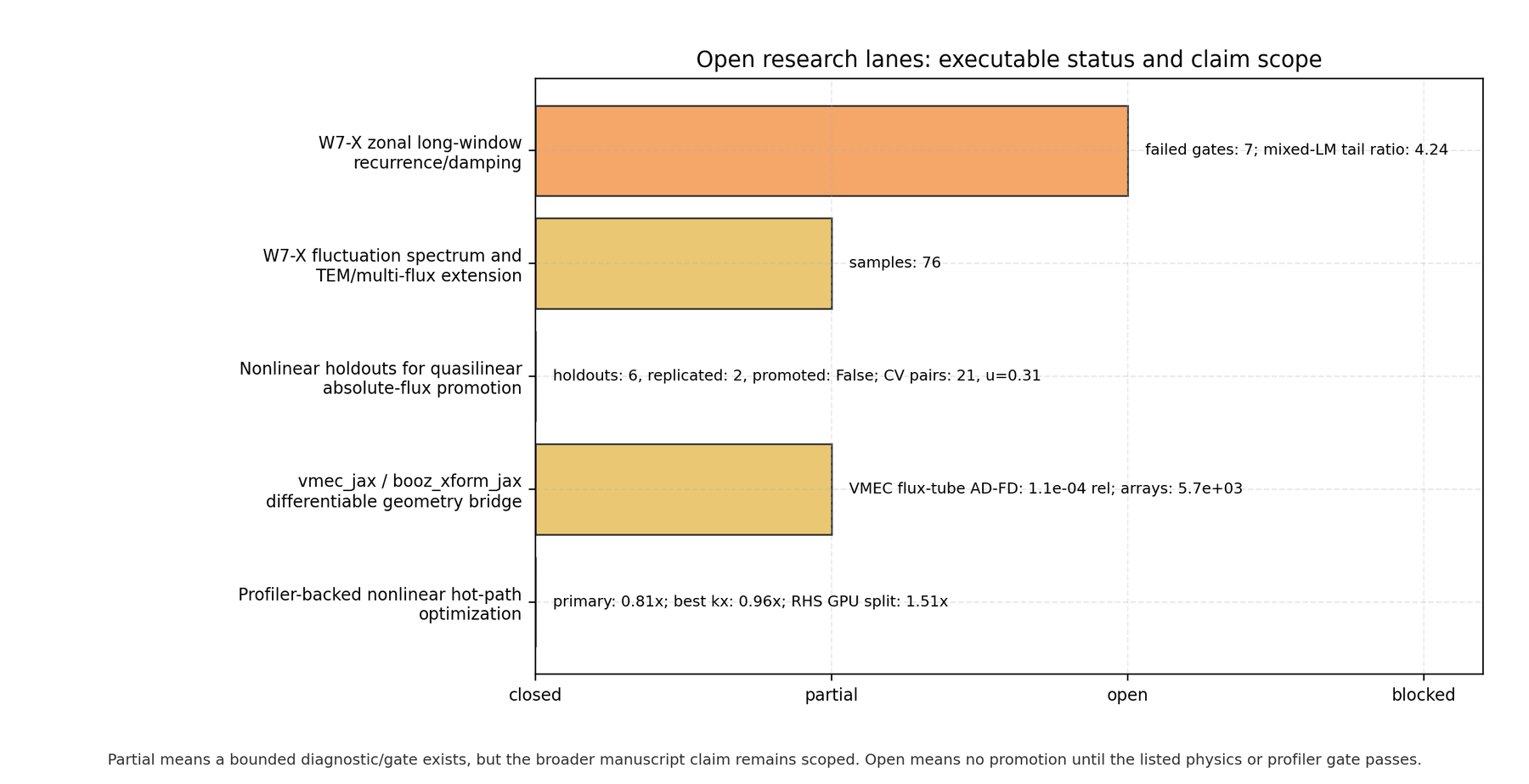
In the broader research tracker, the current snapshot has two closed release/research-support lanes: nonlinear holdouts for the scoped quasilinear model-development claim and profiler-backed nonlinear hot-path localization. W7-X fluctuation/TEM and the broader differentiable-geometry bridge remain partial bounded diagnostics, while W7-X long-window zonal recurrence remains open. This keeps the README/docs claim surface honest while still preserving publication-ready diagnostic panels for the pieces that are already reproducible.
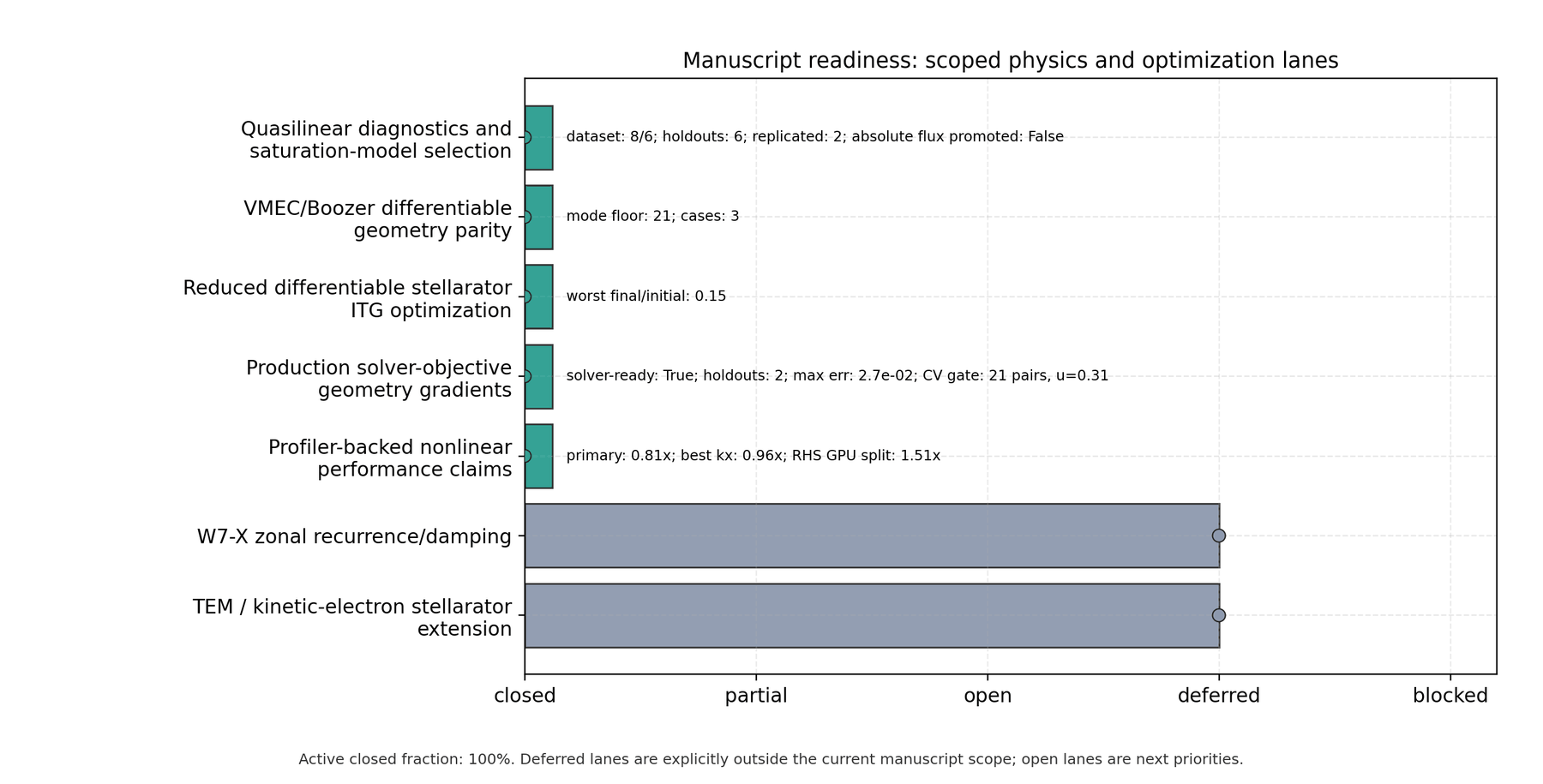
Current manuscript-scope readiness is tracked separately by
tools/build_manuscript_readiness_status.py because W7-X zonal recurrence
and TEM/kinetic-electron extensions are intentionally deferred from this
manuscript. In that narrower scope, the quasilinear lane is closed as a
validated diagnostic/model-selection result rather than as an absolute-flux
predictor, VMEC/Boozer equal-arc geometry parity is closed for the current
artifact-passing mboz=nboz=21 rows, including fixed-resolution QI after the
half-mesh convention fix. The evaluated QI robustness variants pass, while the
full QI seed campaign is artifact-limited by missing bundled wout files.
The reduced
differentiable stellarator ITG optimization examples are closed with AD/FD
gates. The solver-objective geometry-gradient
lane has passed actual linear-RHS gates at the solver-ready geometry contract
plus mode-21 VMEC/Boozer state-to-solver eigenfrequency, quasilinear
heat-flux-weight, and reduced nonlinear-window-estimator gates on QH and Li383
holdouts. Compact nonlinear startup-window finite-difference observable audits
are tracked at docs/_static/nonlinear_window_fd_audit.png / .json and
docs/_static/vmec_boozer_nonlinear_window_fd_audit.png / .json. These
short artifacts validate plumbing only and explicitly are not heat-flux
transport averages. The production guard at
docs/_static/production_nonlinear_optimization_guard.png / .json records
that D-shaped and circular long post-transient replicate ensembles now pass as
holdout evidence, and the selected optimized QA equilibrium now has its own
replicated t=[350,700] post-transient transport-window audit. A matched
finite-transform no-ESS reference from the same VMEC-JAX campaign now also
passes the same ensemble protocol, and the optimized QA/ESS equilibrium reduces
the audited late-window heat flux by 18.4%. The remaining promotion step is
production nonlinear turbulence-gradient evidence or broader matched
baseline-to-optimized finite-difference audits with local-gradient conditioning
and converged long post-transient running-average heat-flux windows. Those are
required before claiming a production nonlinear heat-flux stellarator optimizer.
The latest QL-seeded nonlinear-gradient control screen admits
Rsin_mid_surface_m1 and Zcos_mid_surface_m1 as internal VMEC-state
controls. The first measured mapping response is a negative result:
stellarator-symmetric RBC/ZBS perturbations have zero response in those
admitted asymmetric controls. The follow-up LASYM=true RBS/ZBC branch
now passes the state-to-input mapping gate with rank 2 and condition number
about 1.02, so docs/_static/nonlinear_gradient_state_control_runbook.json
can emit checked short-bracket launch directions. The launch writer now also
has normally terminated VMEC decks and prepared bounded nonlinear campaign
manifests for both mapped controls. The first bounded nonlinear audit has now
run all 18 short-bracket outputs and passed output/ensemble gates, but it
fails central finite-difference promotion because the 1e-3 bracket has
unresolved, asymmetric response. The follow-up bracket-amplitude sweep has also
run all 36 alpha_delta=3e-3 and 1e-2 office-GPU outputs with no
runtime failures. Output and ensemble gates remain stable, but all four
central-FD gates still fail; the best response fraction is about 0.0045
against the 0.03 gate. The remaining open work is therefore not a larger
single-control bracket, but lower-variance evidence through longer
post-transient windows, paired replicas, or better-conditioned multi-control
observables before any production nonlinear-gradient claim.
The VMEC-JAX aspect-6 QA transport restart now has a measured reduced
transport-gradient diagnostic and a solved-gate projected line-search bracket.
The explicit single-sample nonlinear-window metric decreases from
0.0580559 to 0.0559975 at projected step 1e-3 while the physical
aspect/iota/QS gates pass; the next step 2e-3 is rejected by the QS gate.
This closes the local-sensitivity question for the current scalar-weight
ladder failure and the projected line-search/admission path is now reusable.
The matched long-window nonlinear audit for the earlier aspect-6 accepted
1e-3 candidate is negative: both baseline and projected-candidate
seed/timestep ensembles pass
their t=[350,700] gates, but the projected candidate raises the ensemble
mean heat flux slightly from 9.833 to 9.891 (relative reduction
-0.00585). The next implementation task is therefore not to promote this
boundary step, but to add better-conditioned multi-sample objectives and
matched long-window audits before any turbulent-flux optimization claim. The
new qa_projected_transport_step1e3_redesign_report.json gate now records
that requirement explicitly and recommends an 18-point reduced objective over
three surfaces, two field-line labels, and three k_y values.
The stricter rerun-WOUT top-12 QA edge campaign used that 18-point coverage
and improved the reduced metric by 2.29%, but its matched long-window
nonlinear audit still failed promotion with only 0.58% reduction and
uncertainty z-score 0.20. The companion
strict_qa_top12_edge_redesign_report.json therefore marks the next blocker
as predictive transfer margin and uncertainty separation, not merely sample
coverage.
Before tagging, the latest public main CI run must pass repo hygiene, mypy,
quick shards, docs/packaging, fast coverage, and the full wide-coverage matrix.
The configured wide-coverage job enforces 95% package-wide coverage. Some
individual modules can still sit below 95% because the gate is package-wide;
notably nonlinear.py and zonal_validation.py remain useful targets for
future targeted physics tests.
The latest W7-X zonal follow-up is
docs/_static/w7x_zonal_hypercollision_probe_kx070.png. It varies constant
Hermite hypercollision at fixed paper-facing initializer and normalization.
The stronger nu_hyper_m=0.03 row reduces the final Hermite-tail fraction to
about 0.099 but leaves the mean trace error near 0.289 and the
late-window envelope about 4.3 times the digitized reference. The next
step is therefore a physically motivated velocity-space closure/operator
study, not a normalization change or another single-parameter constant-damping
scan.
The W7-X fluctuation/TEM extension lane is tracked by
docs/_static/w7x_tem_extension_status.png and the TEM branch audit
docs/_static/tem_branch_parity_audit.png. The nonlinear fluctuation
spectrum estimator is closed as a simulation diagnostic with 76 samples,
but the TEM branch audit remains far outside any publication parity envelope:
max |rel gamma|≈4.25, max |rel omega|≈3.3 away from the near-zero
reference denominator, one growth-rate sign mismatch, three frequency sign
mismatches, and an inverted frequency-branch ordering. No multi-alpha,
multi-surface, or kinetic-electron W7-X nonlinear windows are admitted yet.
These are now explicit blockers before broad W7-X/TEM validation or
optimization claims.
Post-release scope
The following remain post-release manuscript lanes until their literature contracts and gates close:
W7-X zonal long-window damping, recurrence, and closure under paper-facing normalization;
W7-X fluctuation-spectrum experimental extension: the simulation-spectrum panel now has a reproducible estimator and gated artifact, but density and zonal-frequency comparison through a Doppler-reflectometry transfer function remains post-release;
W7-X multi-flux-tube and TEM extension before broad stellarator-validation claims.
production nonlinear heat-flux stellarator optimization beyond the selected QA audit, including converged VMEC/Boozer nonlinear transport gradients and broader optimized-equilibrium nonlinear audits.
Current release-scope guardrail
The canonical claim ledger for release notes and manuscript drafting is now Release Scope and Claim Boundaries. It records which claims are supported by the current artifacts and which remain explicitly unpromoted. In short: release-level validation is closed for the scoped benchmark, quasilinear diagnostic/model- selection, artifact-passing reduced differentiable-geometry, independent-work parallelization, runtime/refactor artifact-contract, and profiler-localization claims, including the fixed-resolution QI equal-arc row after the half-mesh convention fix and the scoped selected-QA optimized-equilibrium audit. Production nonlinear heat-flux stellarator optimization beyond that selected audit, broad QI validation, runtime absolute quasilinear flux prediction, electromagnetic quasilinear calibration, nonlinear multi-GPU speedup, W7-X zonal recurrence closure, and W7-X TEM/kinetic-electron validation remain future gates.
Active refactor lane
The current branch is splitting large modules into smaller, tested units while preserving public behavior and benchmark parity. Refactors should only land when they add or preserve tests for the extracted behavior.
Current refactor status: runtime startup, GX-comparison diagnostics, adaptive chunks,
runtime result assembly, pure runtime policies, linear parameter policies,
linear linked-boundary maps, nonlinear diagnostic packing, validation-gate
helpers, zonal-validation helpers, and nonlinear parallelization policy metadata
are split out and tested.
Benchmark normalization/Krylov defaults and pure benchmark helpers are also
separated from the public runner module while preserving the
spectraxgk.benchmarks compatibility surface. The latest restart-artifact
contract keeps NetCDF continuation appends on the persisted diagnostic schema.
Treat this as release engineering: it supports maintenance, restart
reproducibility, and future refactors, not a production nonlinear optimization
or broad validation claim.
Highest-value remaining slices:
runtime.pyrun dispatch, artifact writing, and plotting hooks;linear.pycache construction, field solve calls, RHS kernels, and integration paths;nonlinear.pybracket kernels and long diagnostic integration paths;benchmarks.pyrunner orchestration and benchmark artifact policy;plotting and publication-figure helpers;
VMEC/Miller geometry adapter boundaries.
Validation gates
Research-facing validation is organized around artifact gates. Each gate should have an owning script, frozen output path, reference source, fit/window policy, and explicit numeric tolerance.
Linear gates:
growth rate and real frequency from late-time fits;
branch continuation and near-marginal behavior;
eigenfunction overlap and phase/sign conventions;
velocity-space and field-line resolution convergence;
geometry-contract parity for Miller and VMEC imports.
Nonlinear gates:
windowed heat-flux statistics rather than single-time comparisons;
mode-resolved
Wphiand heat-flux spectra;conservation/free-energy behavior in reduced limits;
restart and diagnostic-order regressions;
stable long-window behavior for Cyclone, Miller, KBM, W7-X, and HSX lanes.
Response-function gates:
Rosenbluth-Hinton/GAM response in shaped tokamak cases;
W7-X and HSX zonal-flow response using the same extraction protocol;
damping, frequency, residual, and recurrence diagnostics reported together.
Autodiff gates:
finite-difference, tangent, and adjoint consistency where applicable;
sensitivity maps for growth rates, frequencies, and selected transport metrics;
two-parameter inverse problems with covariance/uncertainty estimates;
differentiable geometry gradients after the
vmec_jaxbridge is added.
Near-term physics priorities
The next physics lanes should be closed in this order after the pre-release scope above is stable:
W7-X zonal-response residual and late-envelope closure. The VMEC-backed SPECTRAX-GK artifact now uses the paper-facing potential initializer, signed line-average observable, line-first normalization, and no hidden time-axis scaling. The long-window comparison reaches the digitized stella/GENE time windows for all four wavelengths, but residuals fail at
k_x rho_i=0.07,0.10, and0.30and the late envelopes are much larger than the digitized traces. The tracked TOML keepsgaussian_width=1because the benchmark source writes the initializer asexp[-(z-z0)^2]; wider profiles and non-unit time scales are explicit audits only. The runtime now preserves final samples under strided diagnostics, aborts checkpointed artifact runs on the first non-finite diagnostic chunk, and preserves signed zonal line/mode diagnostics across external restart continuation. A four-wavelengthNl=16,Nm=64,dt=0.05refresh reached raw runtimet≈100with finite signed traces, so longer restart-continued W7-X traces can now be used to study the remaining physics/numerics issue directly. A constant-Hermite hypercollision follow-up reduced moment-tail energy but did not close the trace residual or late envelope, so the next sweep should vary the closure/operator physics rather than simply increasing constant damping.Tighten the now-materialized windowed nonlinear-statistics panel beyond the current
0.10release gate where the literature/reference windows justify stricter tolerances.W7-X multi-flux-tube ITG/TEM extension and fluctuation-spectrum lane. The simulation-spectrum estimator is closed, while TEM linear parity, alpha/surface-resolved scans, and kinetic-electron nonlinear windows remain open in
docs/_static/w7x_tem_extension_status.jsonanddocs/_static/tem_branch_parity_audit.json.Shaped multispecies tokamak linear lane.
ETG nonlinear only after its benchmark operating point and observable contract are explicit.
Performance and memory
Performance work should stay measurement-driven. The current priorities are:
separate cold compile, cache construction, first-step compile, warm runtime, and output/plot time in every reported panel;
reduce integrator compile cost before optimizing small runtime kernels;
keep large constants out of closed-over JIT state when possible;
stream diagnostics rather than materializing full histories by default;
expose JAX memory-allocation and persistent-cache guidance for production sweeps;
use distributed parallelization first for independent scans, UQ ensembles, sensitivity sweeps, and linear batches before attempting nonlinear domain decomposition;
only introduce custom kernels after profiling shows a persistent XLA bottleneck.
Differentiable geometry and optimization
After the refactor/testing lane is stable, the differentiable geometry plan is:
Replace the remaining local grad-\(B\) drift closure with the production VMEC/EIK drift convention.
Add gradient checks for geometry-to-observable paths.
Promote examples from sensitivity analysis to inverse design, uncertainty quantification, and stellarator optimization only after the derivative checks and benchmark artifacts are frozen.
Testing and CI
The package-wide coverage target remains 95%, but coverage alone is not the goal. Tests should map to equations, numerical schemes, diagnostics, artifacts, benchmark observables, or differentiability contracts.
CI tiers:
pull requests: type checks, fast test shards, docs build, package build, and release-surface coverage;
main/manual: wider package coverage and selected artifact checks;
workflow dispatch: full local validation suite;
office/manual: GX-comparison parity, VMEC/W7-X validation, runtime/memory sweeps, and multi-GPU checks.
Documentation and examples
Documentation should remain user-first at the top level: install, run the executable, plot an output file, inspect diagnostics, and reproduce shipped figures. Longer benchmark caveats belong in the verification and benchmark pages.
Examples that should stay maintained:
default Cyclone linear run and plotting;
Miller geometry;
VMEC imported geometry;
W7-X and HSX nonlinear runs;
plotting from output files;
autodiff inverse/UQ examples;
profiling and memory diagnostics;
parallelization examples.
Release policy
PyPI publishing is handled through the tag-driven GitHub release workflow. Release notes should distinguish closed lanes from open paper lanes. Open research artifacts can be included in the roadmap, but should not be described as validated until their scripts, outputs, references, and gates are frozen.