Linear benchmark master panel |
tools/artifacts/make_benchmark_atlas.py
|
Closed for the release atlas; paper-level extensions remain scoped |
Cyclone ITG, ETG, KBM, W7-X, HSX, and shaped tokamak coverage are represented in docs/_static/benchmark_core_linear_atlas.png. TEM/kinetic-electron branch parity and additional W7-X multi-flux-tube scans remain outside the current release claim. |
Eigenfunction validation panel |
tools/artifacts/generate_linear_reference_overlays.py overlap-summary, tools/artifacts/generate_linear_reference_overlays.py reference-overlay, tools/artifacts/generate_linear_reference_overlays.py kbm, and tools/artifacts/generate_linear_reference_overlays.py w7x
|
Closed for KBM and W7-X raw overlays |
first shipped overlap artifact is docs/_static/kbm_eigenfunction_overlap_summary.png; frozen raw GX bundles now exist for KBM and W7-X under docs/_static/comparison/reference_modes/. The closed KBM raw overlay is docs/_static/kbm_eigenfunction_reference_overlay_ky0p3000.png with overlap 0.999985 and relative L^2 mismatch 0.00721. The closed W7-X raw overlay is docs/_static/w7x_eigenfunction_reference_overlay_ky0p3000.png with overlap 0.9999999994 and relative L^2 mismatch 3.33e-5 against the finite GX t≈2 raw-mode bundle. Both overlay generators write JSON gate reports with overlap >= 0.95 and relative L^2 <= 0.25 requirements. tools/comparison/compare_gx_kbm.py --branch-summary-json writes branch-continuity gate metadata for selected KBM scans, and tools/artifacts/build_linear_validation_artifacts.py kbm-branch refreshes the no-rerun tracked artifact docs/_static/kbm_branch_gate_summary.json from docs/_static/comparison/kbm_reference_candidates.csv. The current continuity-first branch summary passes the strict adjacent growth/frequency jump and successive-overlap gates. |
Nonlinear transport panel |
tools/comparison/make_reference_panels.py summary / tools/comparison/make_reference_panels.py publication
|
Closed for release-window gates; stricter manuscript tightening remains open |
Cyclone, Miller, KBM, W7-X, HSX with matched windows. Current component artifacts: docs/_static/nonlinear_cyclone_diag_compare_t400.png, docs/_static/nonlinear_cyclone_miller_diag_compare_t122.png, docs/_static/nonlinear_kbm_diag_compare_t400_stats.png, docs/_static/nonlinear_w7x_diag_compare_t200.png, docs/_static/hsx_nonlinear_compare_t50_true.png. tools/comparison/compare_gx_nonlinear.py diagnostics --summary-json writes machine-readable mean-relative-mismatch gates for each plotted diagnostic with explicit transport-window bounds. The materialized release-window metadata are docs/_static/nonlinear_cyclone_gate_summary.json, docs/_static/nonlinear_cyclone_miller_gate_summary.json, docs/_static/nonlinear_kbm_gate_summary.json, docs/_static/nonlinear_hsx_gate_summary.json, and docs/_static/nonlinear_w7x_gate_summary.json; all pass the current release gate. This is sufficient for the release validation atlas. Paper-level tightening remains open where case-specific references support narrower tolerances, and the older short Cyclone t=5 diagnostic remains documented as an exploratory startup/resolved-spectrum audit, not a release gate. |
W7-X exact-state convention audit |
tools/comparison/build_exact_state_audit.py run and tools/comparison/build_exact_state_audit.py report
|
Closed |
current artifact base: docs/_static/w7x_exact_state_audit.png with CSV/JSON/PDF companions. It compares W7-X nonlinear VMEC startup state, late geometry/field arrays, and re-evaluated scalar diagnostics directly against GX exact-state dumps. The maximum finite pointwise relative error is 4.62e-5 under the explicit 1e-4 convention gate, while scalar diagnostics are below 1.8e-7. This closes the geometry/diagnostic convention layer but does not close the separate W7-X zonal-response recurrence lane. |
Windowed-statistics summary |
tools/artifacts/build_nonlinear_validation_panels.py window-statistics
|
Closed for current release-window gates |
current artifact base: docs/_static/nonlinear_window_statistics.png with CSV/JSON/PDF companions. It summarizes the per-diagnostic mean_rel_abs and max_rel_abs statistics from the frozen nonlinear GX comparison gate JSONs for Cyclone, Cyclone Miller, KBM, W7-X, and HSX. Exploratory/short-run diagnostics are explicitly excluded with gate_index_include=false. |
Nonlinear startup-window finite-difference audit |
tools/artifacts/build_nonlinear_window_fd_audit.py
|
Closed only as compact startup plumbing; transport-average and gradient promotion open |
current artifact base: docs/_static/nonlinear_window_fd_audit.png with CSV/JSON/PDF companions. It runs actual compact SPECTRAX-GK nonlinear Cyclone startup windows at R/LTi = base +/- step plus a repeated base point, then checks finite outputs, repeatability, monotonic drive response, startup-window coefficient of variation, startup-window trend, and resolved central finite-difference response. The tracked response/base fraction is about 0.111. Its transport_average_gate is false because the run is too short for a post-transient running average; it is not a production nonlinear heat-flux, VMEC/Boozer nonlinear state-gradient, or optimized-equilibrium transport claim. |
VMEC/Boozer nonlinear startup finite-difference audit |
tools/artifacts/build_vmec_boozer_nonlinear_window_fd_audit.py
|
Closed only as VMEC/Boozer geometry-perturbed startup plumbing; transport-average and local-gradient promotion open |
current artifact base: docs/_static/vmec_boozer_nonlinear_window_fd_audit.png with CSV/JSON/PDF companions. It starts from the real mode-21 vmec_jax -> booz_xform_jax QH state bridge, writes perturbed sampled geometries to temporary NetCDF files, and runs compact nonlinear startup windows at Rcos_mid_surface_m1 = base +/- 1e-5 plus a repeated base point. The gate checks finite outputs, deterministic repeatability, bounded startup-window coefficient of variation and trend, resolved geometry perturbation, and resolved central finite-difference response; response/base is about 0.040. Its transport_average_gate is false and the forward/backward response is asymmetric, so this is a startup observable-path audit rather than a promoted transport average, local nonlinear gradient, or optimized-equilibrium transport claim. |
VMEC-state nonlinear-gradient launch runbook |
tools/campaigns/design_nonlinear_gradient.py ql-seed-screen, tools/campaigns/design_nonlinear_gradient.py state-control-runbook, tools/campaigns/write_vmec_state_mapping_campaign.py symmetric, tools/campaigns/write_vmec_state_mapping_campaign.py asymmetric, tools/campaigns/write_vmec_state_control_short_bracket_launch.py, and tools/artifacts/build_vmec_state_to_input_mapping_response.py
|
Closed for checked short-bracket launch mapping; long-window nonlinear-gradient evidence still required |
current artifact bases: docs/_static/nonlinear_gradient_state_control_runbook.png, docs/_static/nonlinear_gradient_state_to_input_mapping_campaign.png, docs/_static/nonlinear_gradient_state_to_input_mapping_response.png, docs/_static/nonlinear_gradient_asymmetric_state_to_input_mapping_campaign.png, docs/_static/nonlinear_gradient_asymmetric_state_to_input_mapping_response.png, docs/_static/nonlinear_gradient_state_control_short_bracket_launch_status.png, docs/_static/nonlinear_gradient_state_control_short_bracket_nonlinear_audit_status.png, and docs/_static/nonlinear_gradient_state_control_bracket_sweep_status.png with CSV/JSON/PDF companions. The QH/Li383 QL seed screen admits Rsin_mid_surface_m1 and Zcos_mid_surface_m1 as sign-consistent internal VMEC-state controls. The measured RBC/ZBS response matrix is rank zero, as expected for the symmetry-forbidden branch, but the follow-up LASYM=true RBS/ZBC response has rank 2 and condition number about 1.02. The runbook now carries explicit least-squares input-control directions for both admitted controls, and the short-bracket launch status records six normally terminated VMEC solves plus two prepared bounded nonlinear campaign manifests. The first nonlinear audit completes all 18 runs and passes output/ensemble gates, but both central-FD gates fail closed because the 1e-3 bracket response is too small and asymmetric. The follow-up 3e-3/1e-2 bracket-amplitude sweep completes all 36 office-GPU runs, but all four central-FD gates still fail with response fractions below 0.005. This is launch-mapping and negative single-control bracket evidence, not yet a converged long-window nonlinear-gradient result. |
Nonlinear-gradient control-variate campaign |
tools/artifacts/build_nonlinear_gradient_evidence.py variance-plan and tools/campaigns/design_nonlinear_gradient.py control-variate-campaign
|
Closed for the rel7.5 independent control-mean uncertainty gate; broader nonlinear-gradient claims remain scoped |
current artifact bases: docs/_static/qa_ess_zbs10_rel7p5_variance_reduction_plan.png, docs/_static/qa_ess_zbs10_rel7p5_control_variate_campaign_plan.png, and docs/_static/qa_ess_zbs10_rel7p5_control_mean_tmin600_t1100_gate.png with JSON/CSV/PDF companions. The rel7.5 ZBS(1,0) follow-up is local and response-resolved but variance limited. The midpoint common-mode control variate reduces apparent residual uncertainty to 0.238; the independent follow-up completes 21 matched plus/minus pairs and the strict late-window gate over t=[600,1100] passes with combined response uncertainty 0.311 < 0.5. This closes the evidence record for this specific variance-reduced nonlinear-gradient lane, not a universal nonlinear turbulent-flux optimization result. |
Nonlinear transport time-horizon audit |
tools/artifacts/build_nonlinear_transport_horizon_audit.py
|
Closed as claim-scope guardrail; QH/CTH convergence promotion open |
current artifact base: docs/_static/nonlinear_transport_time_horizon_audit.png with CSV/JSON/PDF companions. It audits the actual simulated time and claim scope for release nonlinear gates, startup finite-difference audits, reduced nonlinear-window estimators, and external-VMEC feasibility pilots. The new QH reduced-grid nonlinear pilot is extended from the earlier startup-scale t=20 trace to t=150 and reaches a meaningful late heat-flux window with mean about 19.6; it remains a feasibility result until a grid/window convergence gate passes. This panel prevents startup 1e-11-scale heat fluxes or reduced-envelope outputs from being described as post-transient nonlinear transport averages. |
Validation gate index |
tools/release/check_validation_coverage_manifest.py gate-index
|
Current release-gate audit with quasilinear model-selection deliberately open |
current artifact base: docs/_static/validation_gate_index.png and docs/_static/validation_gate_index.json. This is not a physics result by itself; it is the audit panel for materialized release-window gates. The current index records 17/18 passed: the shaped-pressure external-VMEC high-grid admission gate is included as a passed scoped holdout, while docs/_static/quasilinear_model_selection_status.json remains open because the required spectral-envelope candidate misses the strict transport-error gate and is not promoted as an absolute-flux predictor. |
Open research lane status |
tools/artifacts/build_research_status.py open-lanes
|
Closed as a claim-scope audit; underlying physics lanes remain scoped |
current artifact base: docs/_static/open_research_lane_status.png with CSV/JSON/PDF companions. It reads the W7-X zonal recurrence, W7-X hypercollision probe, W7-X fluctuation/TEM extension status, quasilinear holdout, differentiable-geometry, and nonlinear-profiler artifacts and records which lanes are closed, partial, open, or blocked. The current status is intentionally conservative: nonlinear holdouts for the scoped quasilinear model-development claim and profiler-backed nonlinear hot-path localization are closed; W7-X fluctuation/TEM and differentiable geometry are partial bounded diagnostics; and W7-X long-window zonal recurrence/damping remains open. This panel is useful for the paper plan and release notes because it prevents partial diagnostics from being described as completed physics claims. |
Manuscript-readiness status panel |
tools/artifacts/build_research_status.py manuscript-readiness
|
Current manuscript scope with W7-X zonal and TEM deferred |
current artifact base: docs/_static/manuscript_readiness_status.png with CSV/JSON/PDF companions. It records the narrower manuscript scope where W7-X zonal recurrence and TEM/kinetic-electron extensions are deferred. In that scope, quasilinear diagnostics and saturation-model selection are closed as a validated negative/model-selection result rather than as an absolute-flux predictor; VMEC/Boozer zero-beta equal-arc geometry parity is closed at mboz=nboz=21; reduced differentiable stellarator ITG optimization is closed with AD/FD gates; and production solver-objective geometry gradients are closed for solver-ready arrays plus mode-21 VMEC/Boozer eigenfrequency, quasilinear heat-flux-weight, and reduced nonlinear-window estimator gates on QH and Li383. The compact nonlinear FD audits are retained only as startup plumbing checks with false transport-average gates. The production nonlinear optimization guard adds the D-shaped and circular long post-transient replicated holdout ensembles plus the selected optimized-equilibrium t=[350,700] seed/timestep replicated audit. Broader nonlinear turbulence-gradient, absolute-flux prediction, and multi-surface stellarator optimization claims remain separate gates. |
Aspect-6 QA low-turbulence optimization comparison |
tools/artifacts/build_qa_transport_validation_artifacts.py comparison and horizon-audit
|
Closed for reduced differentiable optimization-plumbing claims |
current artifact bases: docs/_static/qa_low_turbulence_comparison.png and docs/_static/qa_low_turbulence_time_horizon_audit.png with JSON/CSV/PDF companions. The panel compares a reduced QA constraints-only optimum against a reduced QA plus nonlinear-envelope optimum at aspect A = 6 and minimum mean iota = 0.41. It includes the fixed-a/L_T Q_env versus a/L_n scan, fixed-gradient reduced-envelope traces, objective histories, reduced non-axisymmetric LCFS surfaces colored by |B|, reduced Boozer-LCFS |B| maps, and gradient/constraint gates. The tracked artifact passes scalar, residual, and observable AD/finite-difference gates, runs the fixed-gradient reduced envelope to t v_ti/a = 400, enforces the formal iota >= 0.41 floor plus an operating iota >= 0.70 floor, keeps a helical boundary amplitude near 0.16, and shows about 10.7% reduced late-window heat flux at the fixed gradient. The horizon audit compares t=400 against a t=1000 reduced-envelope reference and finds relative late-window mean changes of 1.2e-7 or smaller, with CV/trend/half-window drift below 1e-3. The figure supports a reduced differentiable optimization and visualization claim only; it is not the upstream VMEC-JAX QA_optimization.py final WOUT, and long-window full nonlinear transport optimization remains governed by the production nonlinear audit gates. |
Quasilinear spectrum panel |
tools/artifacts/plot_quasilinear_diagnostics.py spectrum
|
Electrostatic diagnostic closed; absolute-flux prediction not promoted |
current artifact bases: docs/_static/quasilinear_cyclone_spectrum.png, docs/_static/quasilinear_cyclone_miller_spectrum.png, docs/_static/quasilinear_hsx_spectrum.png, and docs/_static/quasilinear_w7x_spectrum.png with CSV/JSON/PDF companions. They show electrostatic linear weights and explicitly uncalibrated mixing-length outputs from examples/linear/axisymmetric/runtime_cyclone_quasilinear.toml, examples/linear/axisymmetric/runtime_cyclone_miller_quasilinear.toml, examples/linear/non-axisymmetric/runtime_hsx_linear_quasilinear.toml, and examples/linear/non-axisymmetric/runtime_w7x_linear_quasilinear_vmec.toml. Scan spectra use requested ky for the x-axis and retain signed selected-mode coordinates as mode_ky when applicable. W7-X was generated from an external VMEC benchmark file via W7X_VMEC_FILE; the equilibrium itself is not shipped. Absolute saturated-flux claims remain open until a held-out nonlinear calibration report passes. |
Quasilinear calibration audit |
tools/artifacts/plot_quasilinear_calibration.py report and tools/artifacts/plot_quasilinear_calibration.py
|
Initial train/holdout artifact closed as a failed model-transfer gate |
current artifact bases: docs/_static/quasilinear_cyclone_calibration_audit.png, docs/_static/quasilinear_cyclone_miller_calibration_audit.png, docs/_static/quasilinear_cyclone_miller_train_holdout.png, docs/_static/quasilinear_hsx_train_holdout.png, docs/_static/quasilinear_w7x_train_holdout.png, the manuscript-facing combined panel docs/_static/quasilinear_stellarator_train_holdout.png, and the input-provenance audit docs/_static/quasilinear_validated_calibration_inputs.png with JSON companions. The current one-constant train/holdout report fits the heat-flux scale on Cyclone and the external-VMEC ITERModel case, then scores ten held-out windows: Cyclone Miller, HSX, W7-X, D-shaped external VMEC, up-down asymmetric external VMEC, circular external VMEC, CTH-like external VMEC, shaped-pressure external VMEC, replicated QP external VMEC, and replicated Solovev external VMEC. The CTH-like and shaped-pressure rows are admitted only under explicit high-grid policies that exclude failed coarse-grid traces, while the QP and Solovev rows are matched to passed replicated nonlinear summary gates. The report intentionally remains calibration_dataset with passed = false because held-out errors exceed the 0.35 gate; the current holdout mean relative error is about 6.49 for the positive-growth mixing-length family. The input audit confirms that every current train/holdout nonlinear artifact maps to a passed nonlinear gate or to a scoped high-grid admission gate, while failed QH and older feasibility pilots remain excluded. This closes the NetCDF/CSV/high-grid-admission calibration machinery and provenance gate but not a calibrated absolute-flux claim. |
Quasilinear saturation-rule sweep |
tools/artifacts/plot_quasilinear_saturation_rule_sweep.py
|
Initial model-development diagnostic closed as a negative result |
current artifact base: docs/_static/quasilinear_saturation_rule_sweep.png with JSON companion. It fits one scalar on the two training cases, Cyclone and external-VMEC ITERModel, then scores the ten held-out windows now admitted for three simple rules: positive-growth mixing length, raw linear heat-flux weight, and an absolute-growth diagnostic. All three fail the held-out absolute-flux gate. The least-bad simple rule is now the linear-weight fit with holdout mean relative error about 4.42; positive-growth mixing length is about 6.49 and the absolute-growth diagnostic is about 6.85. The panel also includes a training-mean null baseline with holdout mean relative error about 1.80. Its JSON promotion_gate has no accepted rules, so future calibrated rules must beat both the quasilinear baselines and this null baseline before being promoted. This supports the next saturation-model lane while preventing premature absolute quasilinear transport claims. |
Shape-aware quasilinear saturation diagnostic |
tools/artifacts/plot_quasilinear_saturation_rule_sweep.py shape-aware
|
Initial leave-one-geometry-out diagnostic closed as a negative result |
current artifact base: docs/_static/quasilinear_shape_aware_saturation.png with JSON/PDF companions. It fits a shared nonlinear/quasilinear spectrum-shape exponent with per-case intercepts, uses only passed shape gates for the exponent fit, then fits the absolute heat-flux scale on training cases and scores each held-out geometry. The shape-aware model gives mean absolute relative error about 0.664 versus 0.624 for the linear-weight baseline and 0.170 for a deliberately simple training-mean null baseline. The JSON promotion_gate is false because the model fails the 0.35 transport gate and does not beat the null baseline on the current four-case dataset. This is retained as a manuscript-facing negative result because it rules out a too-simple one-exponent envelope before stellarator optimization claims. |
Quasilinear candidate uncertainty gate |
tools/artifacts/plot_quasilinear_candidate_uncertainty.py
|
Expanded uncertainty-aware candidate gate retained as a negative/near-miss model-development result |
current artifact base: docs/_static/quasilinear_candidate_uncertainty.png with JSON companion. It adds training-residual 95% prediction intervals to leave-one-geometry-out candidate scoring on the expanded twelve-case electrostatic-compatible candidate dataset, now including high-grid CTH-like, shaped-pressure external-VMEC, replicated QP external-VMEC, and replicated Solovev external-VMEC evidence. The best research candidate remains spectral_envelope_ridge: it uses the positive-growth k_y centroid and heat-flux-weighted k_y width in a three-parameter log-linear ridge model, reaches leave-one-geometry-out mean relative error about 0.697, and has interval coverage 11/12. It is above the 0.35 transport gate, so the JSON promotion_gate is false and no candidate is accepted as an uncertainty-validated absolute-flux model. |
Quasilinear candidate regularization audit |
tools/artifacts/plot_quasilinear_candidate_uncertainty.py regularization-sweep
|
Regularization sensitivity checked; absolute-flux promotion remains blocked |
current artifact base: docs/_static/quasilinear_candidate_regularization_sweep.png with CSV/JSON companions. It sweeps the ridge penalty for the same spectral_envelope_ridge leave-one-geometry-out candidate and verifies that no tested penalty passes the 0.35 transport gate. The best tracked setting is lambda = 0.5 with full-ledger mean relative error about 0.689, held-out mean relative error about 0.764, and interval coverage 11/12. This closes a reviewer-facing tuning ambiguity while preserving the claim boundary: the model is a scoped model-development diagnostic, not a runtime/TOML absolute-flux predictor. |
Stellarator quasilinear usefulness summary |
tools/artifacts/plot_quasilinear_model_development.py stellarator-usefulness
|
Stellarator-facing model-skill and scope summary closed as a scoped model-development figure |
current artifact base: docs/_static/quasilinear_stellarator_usefulness.png with CSV/JSON companions. It compares admitted HSX, W7-X, CTH-like, and shaped-pressure nonlinear heat-flux windows with the simple positive-growth mixing-length rule, the calibrated linear-weight rule, and the best spectral_envelope_ridge model-development candidate. The simple rule predicts zero for HSX and W7-X while the nonlinear windows are finite, and it badly overpredicts shaped-pressure, so it is explicitly rejected as a stellarator absolute-flux proxy. The spectral-envelope candidate is closer on several admitted holdouts but is no longer accepted by the strict uncertainty/model-selection or screening gates; the figure also records that QA is matched-nonlinear-audit-only and QH is excluded until grid/window convergence passes. This figure is a manuscript-facing usefulness/limitation summary, not a runtime/TOML absolute-flux predictor. |
Quasilinear screening and rank-correlation skill |
tools/artifacts/plot_quasilinear_model_development.py screening-skill
|
Screening/correlation gate closed as a failed promotion audit; absolute-flux promotion remains blocked |
current artifact base: docs/_static/quasilinear_screening_skill.png with CSV/JSON companions. It scores the current simple rules and candidate models by Spearman rank correlation, pairwise order accuracy, and mean relative error on the frozen twelve-case electrostatic portfolio. No model passes the full-portfolio and held-out-only rank/correlation gates. The least-bad spectral_envelope_ridge candidate has full/held-out Spearman correlations about 0.636/0.624 and pairwise order accuracies about 0.697/0.689, below the 0.75 gates. The mean-error gate remains empty because the best held-out mean relative error is about 0.697 against the 0.35 gate, so the figure deliberately reports absolute promotion: none and points to better saturation theory on the existing ledger before screening promotion can be reconsidered. |
Quasilinear dataset-sufficiency gate |
tools/artifacts/plot_quasilinear_model_development.py dataset-sufficiency
|
Promotion guard closed for the scoped spectral-envelope candidate; higher-parameter and electromagnetic claims remain blocked |
current artifact base: docs/_static/quasilinear_dataset_sufficiency.png with JSON companion. It audits the validated nonlinear windows before any richer saturation model is promoted. The current electrostatic-compatible set has twelve cases, two explicit training geometries, and ten held-out geometries. That is sufficient for the one-parameter linear-weight candidate, the two-parameter shape-power-law candidate, the three-parameter spectral_envelope_ridge candidate, and the five-parameter linear_state_ridge model at the configured leave-one-out train-to-parameter threshold. The gate still fails closed because the downstream candidate-skill gate is not passed on the expanded ledger. |
Quasilinear model-selection status |
tools/artifacts/plot_quasilinear_model_development.py model-selection-status and spectraxgk.diagnostics.quasilinear_model_selection
|
Model-selection lane demoted by the expanded CTH-like and shaped-pressure holdouts; screening remains unpromoted |
current artifact base: docs/_static/quasilinear_model_selection_status.png with CSV/JSON companion. It consolidates the dataset-sufficiency gate, uncertainty/skill gate, and tracked train/holdout calibration reports into one claim-boundary panel. The required spectral_envelope_ridge candidate reaches leave-one-geometry-out mean relative error about 0.697 with prediction-interval coverage 11/12. It beats the calibrated linear-weight baseline but misses the 0.35 transport gate and no longer passes the strict screening gates, so the model-selection artifact is passed=false with blockers dataset_sufficiency_passed, candidate_uncertainty_passed, required_candidate_accepted, and required_candidate_transport_error. |
Quasilinear holdout-gap report |
tools/artifacts/build_quasilinear_holdout_gap_report.py
|
Absolute-flux promotion boundary quantified; frozen-ledger model blockers explicit |
current artifact base: docs/_static/quasilinear_holdout_gap_report.png with CSV/JSON companion. It keeps absolute_flux_promoted=false and records both absolute_flux_promotion_requirements and screening_promotion_requirements blocks. After adding the replicated Solovev holdout, the current absolute train/holdout error is about 6.49 against the 0.35 gate, no full-portfolio or held-out-only screening model is accepted, and the independent-holdout-count blocker is closed. The CTH-like, shaped-pressure, QP, and Solovev admissions strengthen external-VMEC coverage enough for this tranche; the report now requires a substantially better saturation model and held-out transport skill on the existing ledger before absolute-flux promotion can be reconsidered. |
External-VMEC next-holdout runbook |
tools/artifacts/build_external_vmec_holdout_runbook.py
|
Solovev replicated holdout admitted as negative absolute-QL evidence; QH remains negative evidence |
current artifact base: docs/_static/external_vmec_next_holdout_runbook.png with CSV/JSON companions. It converts the holdout-gap report and external-VMEC linear screen into a fail-closed nonlinear launch plan. The CTH-like modified-protocol harvest is admitted only through tools/release/check_vmec_boozer_gates.py high-grid-admission: the full n48/n64/n80 sidecar fails due to the coarse grid, the retained n64/n80 high-grid gates, late time-horizon gate, and n80 seed/timestep ensemble pass. The shaped-tokamak-pressure repair now follows the same policy: the full n48/n64/n80 t=450 sidecar fails only coarse-grid agreement with pairwise heat-flux shift about 0.469, while retained n64/n80 gates pass at t=450/t=650 and the n80 seed/timestep ensemble passes on t=[325,650] with mean heat flux about 7.16. Both are scoped high-grid holdouts, not full coarse-to-high-grid convergence claims. The corrected nfp4_QH_warm_start modified-protocol ladder reached t=250, t=450, and t=700 at n64/n80 and dt=0.04, but all relaxed 20% high-grid gates fail; the final t=700 common-window and least-window heat-flux differences are about 0.349 and 0.367. A new bounded linear screen added wout_solovev_reference.nc with gamma≈0.0944 at ky≈0.2857 and wout_up_down_asymmetric_tokamak_reference.nc with gamma≈0.0360 at ky≈0.4762. Since up-down asymmetric is already represented, Solovev was run as the next independent nonlinear holdout. Its repaired n48/t250 seed/timestep ensemble passes with <Q_i>=1.409 and mean-relative spread 0.1599 under the explicit 20% gate. This is not an absolute-flux promotion; Solovev enters calibration as negative transfer evidence. |
Pre-manuscript closure action runbook |
tools/artifacts/build_research_status.py runbook
|
Actionable campaign ledger added; claim promotion remains blocked by strict gates |
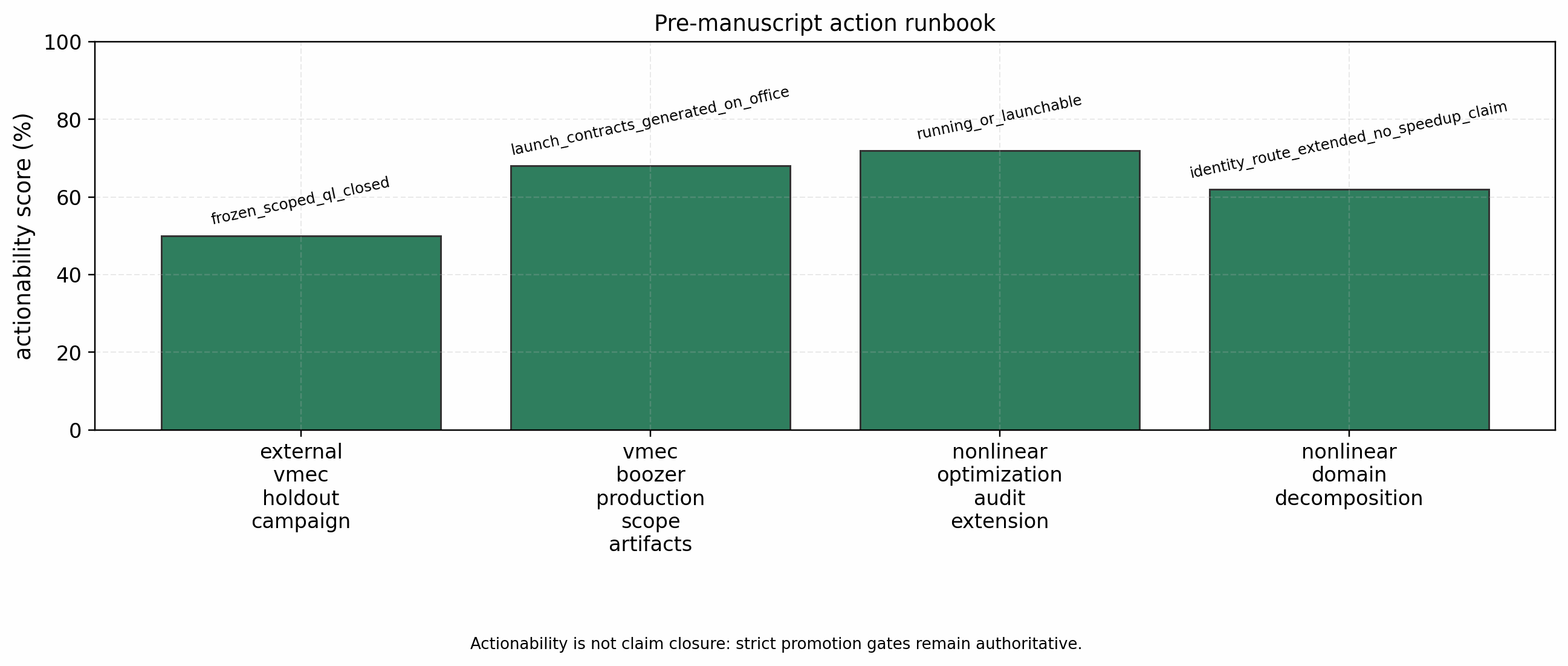
current artifact base: docs/_static/pre_manuscript_closure_runbook.png with CSV/JSON/PDF companions. It combines the strict closure dashboard, the external-VMEC fail-closed holdout runbook, the refreshed VMEC inventory, and optimizer-ladder metadata into one operational ledger. The artifact records Solovev as the harvested independent external-VMEC nonlinear holdout for this tranche, keeps remaining unscreened VMEC candidates behind the linear-screen gate, records the three production-scope optimized-equilibrium nonlinear audit commands generated on office, and logs the detached t=1500 seed queues. It is an action artifact only: launched commands do not promote universal absolute quasilinear flux prediction, broad nonlinear turbulent-flux optimization, VMEC/Boozer optimization, or production nonlinear speedup without the corresponding convergence, replicate, and identity/profiler gates. |
Quasilinear promotion guardrail audit |
tools/release/check_quasilinear_promotion_guardrails.py
|
Fast metadata gate closed; nonlinear simulation validation remains delegated to the source gates |
current artifact: docs/_static/quasilinear_promotion_guardrails.json. It scans the train/holdout calibration reports, saturation-model reports, nonlinear input-validation blocks, promotion gates, claim-scope README/docs wording, the quasilinear row in docs/_static/manuscript_readiness_status.json, and the manuscript quasilinear model-development figure index. It requires finite nonlinear window means and standard deviations for train/holdout calibration points, explicit nonlinear and quasilinear artifact provenance, JSON sidecars for the tracked model-development figures, scoped non-absolute claim levels, explicit failed-baseline or blocker metadata, passed held-out gates before any calibrated_absolute_flux claim, and a manuscript-readiness quasilinear lane that remains scoped as diagnostic/model-selection evidence rather than a runtime absolute-flux predictor. This is deliberately a wording and metadata guard, not a calibrated absolute-flux claim or a replacement for nonlinear convergence simulations. |
Release claim-scope ledger |
docs/release_scope.rst
|
Closed as documentation guardrail |
This documentation page centralizes the current claim boundaries across validation, quasilinear model selection, differentiable geometry, parallelization, performance, and deferred W7-X/TEM lanes. It should be updated whenever a new artifact promotes or demotes a claim. |
VMEC equilibrium portfolio for future quasilinear holdouts |
tools/artifacts/plot_vmec_jax_equilibrium_inventory.py
|
Planning artifact closed; bounded linear smoke checks started; transport validation open |
current artifact bases: docs/_static/vmec_jax_equilibrium_inventory.png, docs/_static/external_vmec_candidate_linear_screen.csv, docs/_static/quasilinear_vmec_qi_seed_branch_refinement_gate.png, docs/_static/vmec_optimization_candidate_screen_gate.json, docs/_static/external_vmec_dshape_t250_high_grid_convergence_gate.png, docs/_static/external_vmec_dshape_replicates/dshape_replicate_t250_ensemble_gate.png, docs/_static/external_vmec_circular_replicates/circular_replicate_t700_ensemble_gate.png, docs/_static/external_vmec_qh_high_grid_convergence_gate.png, docs/_static/external_vmec_cth_like_modified_t350_full_grid_convergence_gate.json, docs/_static/external_vmec_cth_like_modified_late_high_grid_time_horizon_gate.png, docs/_static/external_vmec_cth_like_modified_replicates_t700/replicate_ensemble_gate.png, and docs/_static/external_vmec_cth_like_modified_high_grid_admission_gate.json with companions where tracked. The refreshed inventory now scans 24 external VMEC files from vmec_jax/examples/data without checking them into SPECTRAX-GK, spanning axisymmetric, finite-beta, quasi-axisymmetric, quasi-helical, quasi-isodynamic, stellarator, and general families. DSHAPE and circular external-VMEC holdouts pass the tracked nonlinear gates; QI remains near-marginal; QH remains excluded because all corrected long-window gates fail; CTH-like and shaped-pressure are admitted only as scoped high-grid holdouts. The newest screen first selected Solovev as the independent launch candidate, and the repaired n48/t250 Solovev seed/timestep ensemble is now harvested and admitted as negative absolute-QL evidence; up-down asymmetric remains an already represented audit candidate. Remaining unscreened candidates such as wout_LandremanPaul2021_QA_reactorScale_lowres_reference.nc still require the same linear-screen gate before nonlinear launch. The solved-optimization-WOUT screen adds a metric gate before nonlinear launches from vmec_jax optimization results: qa_nfp2 is marginal, qh_nfp3/qp_nfp4 are stable, and apparent high-growth qp_nfp3 is rejected because effective k_perp^2 is non-positive. |
Quasilinear spectrum-shape gate |
tools/artifacts/plot_quasilinear_diagnostics.py shape-gate
|
HSX, W7-X, and Cyclone Miller gates closed; Cyclone retained as a failed model gate |
current artifact bases: docs/_static/quasilinear_hsx_spectrum_shape_gate.png, docs/_static/quasilinear_w7x_spectrum_shape_gate.png, docs/_static/quasilinear_cyclone_miller_spectrum_shape_gate.png, and docs/_static/quasilinear_cyclone_spectrum_shape_gate.png with JSON/PDF companions. They compare normalized linear heat-flux-weight spectra against normalized nonlinear resolved HeatFlux_kyst spectra. HSX passes with TV≈0.112 and cosine ≈0.971; W7-X passes with TV≈0.056 and cosine ≈0.992; Cyclone Miller passes with TV≈0.094 and cosine ≈0.983; Cyclone is kept as a failed gate with TV≈0.215 and cosine ≈0.896. This supports spectrum-shape diagnostics while identifying a real saturation/window/model limitation before absolute saturated-flux claims. KBM is deferred from this gate because the current quasilinear diagnostic validates electrostatic channels only and the KBM lane is electromagnetic. |
Zonal-flow / GAM response panel |
tools/artifacts/build_zonal_flow_artifacts.py (response-csv, response-output, objective-gate, miller-panel, and collisional-zonal-dk modes), tools/artifacts/build_w7x_zonal_validation_artifacts.py response-panel, tools/artifacts/build_w7x_zonal_reference_artifacts.py digitize, tools/artifacts/build_w7x_zonal_reference_artifacts.py compare, tools/artifacts/build_w7x_zonal_validation_artifacts.py (contract and state-convention modes), tools/artifacts/build_w7x_zonal_recurrence_artifacts.py moment-tail, tools/artifacts/build_w7x_zonal_recurrence_artifacts.py closure-ladder, and tools/artifacts/build_w7x_zonal_recurrence_artifacts.py sweep
|
Open |
The complete P24/J10 Coulomb, original-Sugama, and improved-Sugama Figures 12–14 protocol is closed in docs/_static/collision_finite_wavelength_zonal_response.png with an exact JSON verdict and compact velocity-section companion: all traces reach t nu=30, pass the Xiao residual and finite-wavelength tail-ordering gates, and reproduce the published velocity-section relationships. The broader stellarator-zonal panel remains open: it should combine shaped-tokamak Rosenbluth-Hinton-style residuals with W7-X residual/damping envelopes using one figure convention; use signed Phi_zonal_mode_kxt or case-specific signed line averages for publication claims and keep Phi2_zonal_t only as an intermediate cross-check. The current Merlo Case-III artifact is docs/_static/miller_zonal_response_pilot.png from the initial-density setup at Nz=32, Nl=4, Nm=24, dt=0.005, and t≈60. With Rosenbluth-Hinton first-sample normalization it gives residual≈0.192 against the Merlo et al. Figs. 12/16 read-off of about 0.19; a literature-faithful common fit window t≈30 with separate positive/negative-extrema damping fits gives γ_GAM R0 / v_i≈-0.176 against the paper-scale read-off near -0.17; and Hilbert-phase frequency extraction on that same window gives ω_GAM R0 / v_i≈2.20 against the paper-scale read-off near 2.24. A higher-moment audit lowers the recurrence ratio but over-damps the GAM, while weak hypercollision scans are effectively inert, so the frozen Merlo artifact remains on the current Nm=24 baseline. The W7-X side now uses the potential initializer, signed line-average observable, paper-facing line-first normalization, and no hidden time-axis scaling. The tracked long-window W7-X artifact is docs/_static/w7x_zonal_response_panel.png with replayable traces in docs/_static/w7x_zonal_response_panel.traces.csv; it reaches the digitized Fig. 11 windows, but docs/_static/w7x_zonal_reference_compare.json remains open because residuals fail at k_x rho_i=0.07, 0.10, and 0.30 and the late envelopes are much larger than the digitized stella/GENE traces. docs/_static/w7x_zonal_contract_audit.png is now the paper-facing diagnostic panel for that open mismatch and is intentionally excluded from the release gate index. docs/_static/w7x_zonal_state_convention_audit.png closes the paper-facing state convention layer: the recovered Gaussian potential has relative L2 error 1.85e-6, off-target spectral content is zero to reported precision, and the diagnostic helpers agree with manual line/volume reductions near 2e-16. docs/_static/w7x_zonal_moment_tail_audit.png, docs/_static/w7x_zonal_closure_ladder_kx070.png, docs/_static/w7x_zonal_recurrence_sweep_kx070.png, and docs/_static/w7x_zonal_hypercollision_probe_kx070.png are companion open diagnostics; together they support a recurrence / moment-closure hypothesis and show that weak or constant closure can reduce velocity-space tails without closing the paper trace. The refreshed closure ladder now covers constant Hermite, k_z-weighted Hermite, mixed Laguerre-Hermite, Laguerre-only, and isotropic hypercollision families at 0.01 and 0.03. The best mean trace error is the isotropic nu_hyper=0.01 row at about 0.2755 versus baseline 0.2861, but its late-window standard-deviation ratio is about 4.25 versus baseline 4.10. Thus no bounded closure family improves trace error, late-envelope recurrence, and moment-tail metrics simultaneously. The W7-X generator exposes explicit hypercollision and Gaussian-width audit overrides so future closure probes are reproducible from the tracked tool. A newer high-moment four-wavelength audit under tools_out/zonal_response/w7x_publication_nl16_nm64_dt005_t100 verifies finite signed traces to t≈100 after restart-continuation fixes. The tracked W7-X TOML keeps gaussian_width=1 because the benchmark source writes the initializer as exp[-(z-z0)^2]; wider profiles and non-unit time scales are retained only as audits. The lane remains open pending a more physical W7-X damping/closure and velocity-space recurrence fix under the paper-facing convention. |
W7-X fluctuation-spectrum panel |
tools/artifacts/plot_w7x_fluctuation_spectrum_panel.py and tools/artifacts/build_tem_validation_artifacts.py w7x-extension
|
Initial simulation-spectrum diagnostic closed; TEM/multi-flux validation open |
current artifact bases: docs/_static/w7x_fluctuation_spectrum_panel.png, docs/_static/tem_branch_parity_audit.png, and docs/_static/w7x_tem_extension_status.png with CSV/JSON/PDF companions. The fluctuation panel is regenerated from the gated W7-X nonlinear t≈200 NetCDF artifact, requires the corresponding nonlinear gate summary to pass before plotting, and records gate_index_include=false because it is a diagnostic figure rather than an additional release gate. It shows normalized k_y spectra for |\phi|^2, W_\phi, and |Q_i|, the time-averaged k_x-k_y fluctuation-power map, the signed heat-flux spectrum, and a windowed temporal spectrum for the dominant nonzonal and zonal traces. The TEM audit explicitly keeps TEM linear parity open: maximum absolute relative growth-rate mismatch is about 4.25, maximum absolute relative frequency mismatch is about 3.3 away from the near-zero reference denominator, and the frequency branch has Spearman coefficient about -0.986. Because the TEM reference is a provisional literature digitization rather than a direct case dump, this artifact blocks broad W7-X/TEM validation claims without being a standalone tuning target. The extension-status panel also keeps W7-X multi-alpha/multi-surface scans and kinetic-electron nonlinear windows open. This closes the reproducible simulation-spectrum panel needed for the current manuscript stack but not broad W7-X/TEM validation. |
Velocity-space convergence panel |
tools/artifacts/build_linear_validation_artifacts.py observed-order plus dedicated full convergence refresh script to add
|
Open |
should follow observed-order convergence evidence and write an observed-order gate report through spectraxgk.benchmarks.observed_order_gate_report so convergence rate and final-grid error are tracked explicitly. The current atlas summary already records a machine-readable high-vs-low Cyclone grid convergence gate for the tracked convergence tile. The CSV-backed Cyclone velocity-space artifact is docs/_static/cyclone_resolution_observed_order.png with metadata in docs/_static/cyclone_resolution_observed_order.json; the current office/GPU ky=0.30 sweep passes the strict pairwise-order and final-error gate. |
Stellarator validation panel |
dedicated script to add |
Open |
W7-X multi-flux-tube + zonal-flow response + HSX summary as needed; add heavy-electron EM verification before realistic-electron EM claims |
Performance panel |
existing performance tooling |
Closed for release-level scoped claims |
current artifact bases: docs/_static/runtime_memory_benchmark.png, docs/_static/nonlinear_rhs_profile_miller.png, docs/_static/nonlinear_rhs_profile_stellarator_runtime.png, docs/_static/full_nonlinear_rhs_trace_summary.json, docs/_static/full_nonlinear_rhs_trace_gpu_summary.json, docs/_static/nonlinear_sharding_profile_office_gpu_benchmark_grid.json, and docs/_static/nonlinear_device_z_pencil_transport_gpu2_observable_split_profile.json. The release claim is limited to current cold/warm runtime accounting, CPU/GPU nonlinear RHS hot-path localization, W7-X/HSX runtime-mode stellarator smoke profiles, and fail-closed numerical-identity gates. Whole-state sharding fails identity on the benchmark grid, and the device-z pencil route remains below the two-GPU speedup gate, so neither is a production nonlinear domain-decomposition speedup claim. |
Parallelization identity gate |
tools/artifacts/generate_parallel_identity_gate.py ky-scan
|
Closed for independent Cyclone k_y batching |
current artifact base: docs/_static/parallel_ky_scan_gate.png with CSV/JSON/PDF companions. This is a real linear-solver gate: it compares serial and fixed-shape k_y-batched Cyclone scans, requires numerical identity for gamma and omega, and reports batch speedup separately from the acceptance criterion. |