Benchmarks
SPECTRAX-GK’s benchmark figures are organized as a compact atlas instead of a case-by-case gallery. The layout follows the standard gyrokinetic comparison pattern:
linear growth-rate and real-frequency overlays versus
k_y(orbeta),nonlinear time traces of heat flux, free energy, electrostatic field energy, and magnetic field energy when present,
compact panels that separate exact diagnostic closures from broader stress lanes.
The figures in this page are generated directly from tracked CSV assets,
curated comparison traces, and the small root-level result index under
benchmarks/results. Large run directories are deliberately excluded from
git.
Figure generation
Lightweight benchmark drivers, runtime TOML inputs, and result-index pointers
live in the repository root under benchmarks/. This is the canonical
benchmark entry-point directory for users and developers. It is intentionally
separated from examples/: examples teach workflows, while benchmarks
reproduce validation panels and paper-facing comparison traces. Generated
outputs should go to tools_out/ or another scratch directory; only reviewed,
compressed summary figures and small CSV/JSON metadata are tracked in
docs/_static.
The repository-size contract for this directory is deliberately strict:
benchmarks/ should stay at the scale of small scripts and manifests, not
simulation products. The tracked result manifest under
benchmarks/results/manifest.toml is the docs-facing index for promoted
figures and tables, while NetCDF files, restart files, logs, profiler traces,
and exploratory plots remain outside git.
Quick driver examples:
python benchmarks/cyclone_linear_benchmark.py --outdir tools_out/cyclone_benchmark
python benchmarks/kbm_linear_comparison.py
python -m spectraxgk.cli run-runtime-linear --config benchmarks/runtime_secondary_slab.toml
python benchmarks/secondary_slab_workflow.py
The Cyclone publication driver fits the terminal t=7--10 interval. A
fresh trajectory audit showed that the previous automatic window could select
the short t=5.07--5.38 startup transition and understate the ky=0.3
growth rate by more than a factor of two, even though the late-time mode
converged to the tracked branch.
The KBM plotting driver reads the reviewed fixed-beta ky comparison table.
Use tools/comparison/compare_gx_kbm.py with a matched external output to
regenerate that table; branch selection remains a transitional time-history
policy until the generic runtime reproduces the full scan. The generic runtime
now provides the same CFL-controlled trajectory and can refit multiple branch
extractors from one stored field history; the remaining gate is the converged
full-grid replay, not missing runtime functionality.
Regenerate the atlas figures with:
python tools/artifacts/make_benchmark_atlas.py
The atlas builder now reads its inputs from
tools/benchmark_atlas_manifest.toml and writes a machine-readable summary to
tools_out/benchmark_atlas_summary.json so the panel provenance stays
explicit.
Future velocity-space convergence panels should use the same JSON-ready
gate-report convention before they are promoted into the publication stack.
Capability and matched-comparison contract
benchmarks/capability_matrix.toml is the machine-readable source of truth
for feature scope. It prevents two common errors: implying support because a
related equation exists, and diagnosing a solver mismatch before the two runs
actually use the same physical and numerical contract.
Capability family |
Status |
Current claim |
|---|---|---|
Electrostatic flux-tube dynamics and nonlinear ExB bracket |
validated, scoped by case |
Cyclone, Miller, W7-X, and HSX state/observable gates |
Electromagnetic |
validated, scoped by case |
KAW/KBM linear and KBM nonlinear gates |
Boltzmann and kinetic species in a Hermite–Laguerre basis |
validated, scoped by branch |
adiabatic ITG is core; kinetic-electron/TEM remains a stress lane |
Analytic, Miller, and imported VMEC geometry |
validated, scoped by equilibrium |
axisymmetric and selected W7-X/HSX comparisons |
Restart, spectra, heat flux, and field-energy diagnostics |
validated |
schema plus numerical-identity and windowed-statistics gates |
Independent |
production validated |
CPU/GPU identity and strong-scaling evidence |
Nonlinear multi-device domain decomposition |
blocked |
current benchmark-grid whole-state route is slower and fails identity |
JAX autodiff, implicit gradients, and VMEC/Boozer optimization |
validated, scoped |
AD/FD, conditioning, covariance, geometry parity, and holdout gates |
Conserving Dougherty and linearized Sugama/Coulomb collisions |
validated reduced research boundary |
conserving Dougherty-like runtime model plus published reduced original/ improved-Sugama and Coulomb matrix, invariant, dissipation, relaxation, and derivative gates. Full finite-\(b\) multispecies promotion still requires generated hierarchy, conductivity, ITG, zonal, and resolution evidence. |
VMEC exact-periodic, continuous-drift, and fixed-aspect boundaries |
validated, scoped |
policy tests plus fixed-aspect W7-X/HSX comparison lanes |
Equilibrium \(E\times B\) flow shear |
numerical research API validated; physical model unshipped |
zero-shear, shearing-wave, remap/dealias, cache, linear-suppression,
AD/FD, linked-boundary, and fixed-step IMEX gates pass. The final fixed-
step |
Specialized KREHM, Vlasov–Poisson, collisional-ETG, and Beer/Smith closures |
not shipped |
separate reduced models are outside the full-gyrokinetic release claim |
Species/Hermite multi-device operator execution |
validated electrostatic operator route, scoped |
periodic and linked |
A matched comparison must record the equations and normalization, geometry coefficients and parallel boundary, species conventions, perpendicular and velocity grids, initial condition and seed, precision and de-aliasing, integrator and timestep policy, collision/dissipation settings, diagnostic normalization, and the fit or transport window. A visually similar input file is insufficient. This rule is especially important for nonlinear saturation, where short state-level agreement does not establish a converged heat-flux comparison.
The promoted comparison contract was audited at GX revision bc2fe552. A
fresh office clone confirms that revision and has aggregate source fingerprint
sha256:bfaaadfa...20b. The long-lived instrumented office source tree is not
a Git checkout and has fingerprint sha256:436e403e...a004; these two
provenances must not be interchanged. The older binaries mixed system OpenMPI
and netCDF with local HDF5 and are excluded. An isolated clean-revision rebuild
now links one local OpenMPI 4.1.6, parallel netCDF 4.9.2, and HDF5 1.14.5 stack.
The canonical Cyclone s-alpha probe completed 2,145 steps to t=10 in 23.1 s
and wrote valid netCDF/restart outputs; at ky=0.3 its terminal diagnostic is
(gamma, omega)=(0.101814, 0.286777). GX remains the mature baseline for conventional GPU nonlinear
initial-value runs and species/Hermite multi-device execution. SPECTRAX-GK’s
distinct validated scope is its Python/JAX API, differentiable objectives,
implicit gradient paths, CPU execution, and in-memory vmec_jax/
booz_xform_jax integration. SPECTRAX-GK does not claim the complete finite-
wavelength multispecies linearized Landau hierarchy: its published reduced
Sugama/Coulomb slice remains a separately gated Python research boundary.
Feature parity is intentionally not blanket parity. SPECTRAX-GK’s required comparison scope is the standard electrostatic/electromagnetic gyrokinetic system, not GX’s optional KREHM, Vlasov–Poisson, collisional-ETG, forcing, transport-coupling, or Beer/Smith closure paths. Conversely, differentiable eigen/objective solves and the in-memory JAX geometry chain are SPECTRAX-GK extensions rather than comparison requirements.
The audit also identifies equilibrium \(E\times B\) flow shear as a
scientifically useful extension rather than a compatibility checkbox. Its
coordinate, operator, timestep, and derivative foundations are validated, but
the predeclared fixed-step transport-response gate failed. The implementation
therefore remains a Python research API rather than an input-file feature. The
compact negative-evidence record is
docs/_static/flow_shear_fixed_step_response_gate.json; raw states and large
comparison outputs remain off-repository.
Tracked results index
The root-level result index is benchmarks/results/manifest.toml. It points
to the promoted benchmark figures and machine-readable tables without moving or
duplicating large run products. The current tracked result set is:
Result |
Tracked artifact |
Claim scope |
Regeneration path |
|---|---|---|---|
Core linear benchmark atlas |
|
headline linear validation atlas |
|
Core nonlinear benchmark atlas |
|
headline nonlinear validation atlas |
|
README benchmark summary panel |
|
compact publication-facing benchmark summary |
|
Extended linear stress matrix |
|
stress and provisional lanes, not headline validation claims |
|
Runtime and memory comparison |
|
tracked wall-time and memory comparison rows |
|
Runtime and memory result rows |
|
machine-readable runtime/memory rows used by the tracked panel |
|
Runtime and memory summary |
|
machine-readable summary for runtime/memory panel generation |
|
Core linear atlas inputs |
|
manifest of small tracked benchmark inputs |
|
This keeps the repository light: benchmarks/ stores only drivers and
pointers, docs/_static stores reviewed compact figures/tables, and raw
solver output directories remain untracked. The tracked benchmarks/ payload
is intentionally on the order of tens of kilobytes.
The manifest above is the docs-facing source of truth for promoted benchmark
results. If a new result is added to benchmarks/results/manifest.toml, it
must either appear in this table or remain unpromoted in scratch storage.
This produces the tracked atlas panels:
docs/_static/benchmark_core_linear_atlas.pngdocs/_static/benchmark_core_nonlinear_atlas.pngdocs/_static/benchmark_readme_panel.pngdocs/_static/benchmark_extended_linear_panel.png
PDF copies are emitted alongside each PNG for manuscript workflows.
Fresh-run refresh workflow
The tracked atlas is now paired with a refresh manifest:
python tools/campaigns/run_validation_campaigns.py benchmark-refresh --list
The refresh runner executes the benchmark matrix in manifest order from
tools/benchmark_refresh_manifest.toml and writes a summary to
tools_out/benchmark_refresh_summary.json. Jobs that depend on reference data declare explicit environment-variable requirements for their argument bundles, so the refresh pipeline can be rerun without editing the Python scripts themselves.
The VMEC-backed imported-linear refresh jobs are intentionally pinned to
JAX_PLATFORMS=cpu in the manifest. That keeps the refresh workflow stable
on shared machines such as office where the geometry helper stack can
otherwise fail with GPU out-of-memory errors that are unrelated to parity.
Example:
python tools/campaigns/run_validation_campaigns.py benchmark-refresh --job cyclone-core-assets --job benchmark-atlas
Tracked benchmark metrics
The benchmark atlas uses the same small set of physically interpretable metrics throughout:
growth rate
gammareal frequency
omegaion heat flux
free energy
electrostatic field energy (output variable
Wphi)magnetic field energy when
A_parallelorB_parallelare active
At the README level, these metrics are intentionally packed into one compact publication panel plus one separate runtime/memory panel. The atlas therefore answers two questions:
which branches and diagnostics are being tracked for validation,
which shipped cases have measured CPU/GPU/runtime-memory coverage.
A fresh bounded Cyclone check on 2026-07-10 used RK4 to t=20 at
ky=0.3, N_l=16, and N_m=48 on an RTX A4000. The reference
late-window mean was gamma=0.09582 and omega=0.28106; the unified
runtime with the benchmark-aligned midplane observable returned
gamma=0.09076 and omega=0.27828. Relative errors are 5.3% and 1.0%,
respectively. The compact machine-readable record is
docs/_static/cyclone_runtime_parity_refresh.json. Its wall times must not be
read as a speedup: the reference invocation advanced 12 ky modes, while the
SPECTRAX-GK invocation advanced one.
Primary publication set
The headline validation set is limited to the full-gyrokinetic lanes that are already used in the current validation and regression workflow:
Cyclone ITG linear and nonlinear
KBM linear and nonlinear
W7-X VMEC linear and nonlinear
HSX VMEC linear and nonlinear
Cyclone Miller geometry linear and nonlinear
The README atlas also includes one extended linear strip for exploratory or stress lanes that are still useful to show publicly without folding them into the primary validation claim:
Cyclone kinetic electrons
TEM
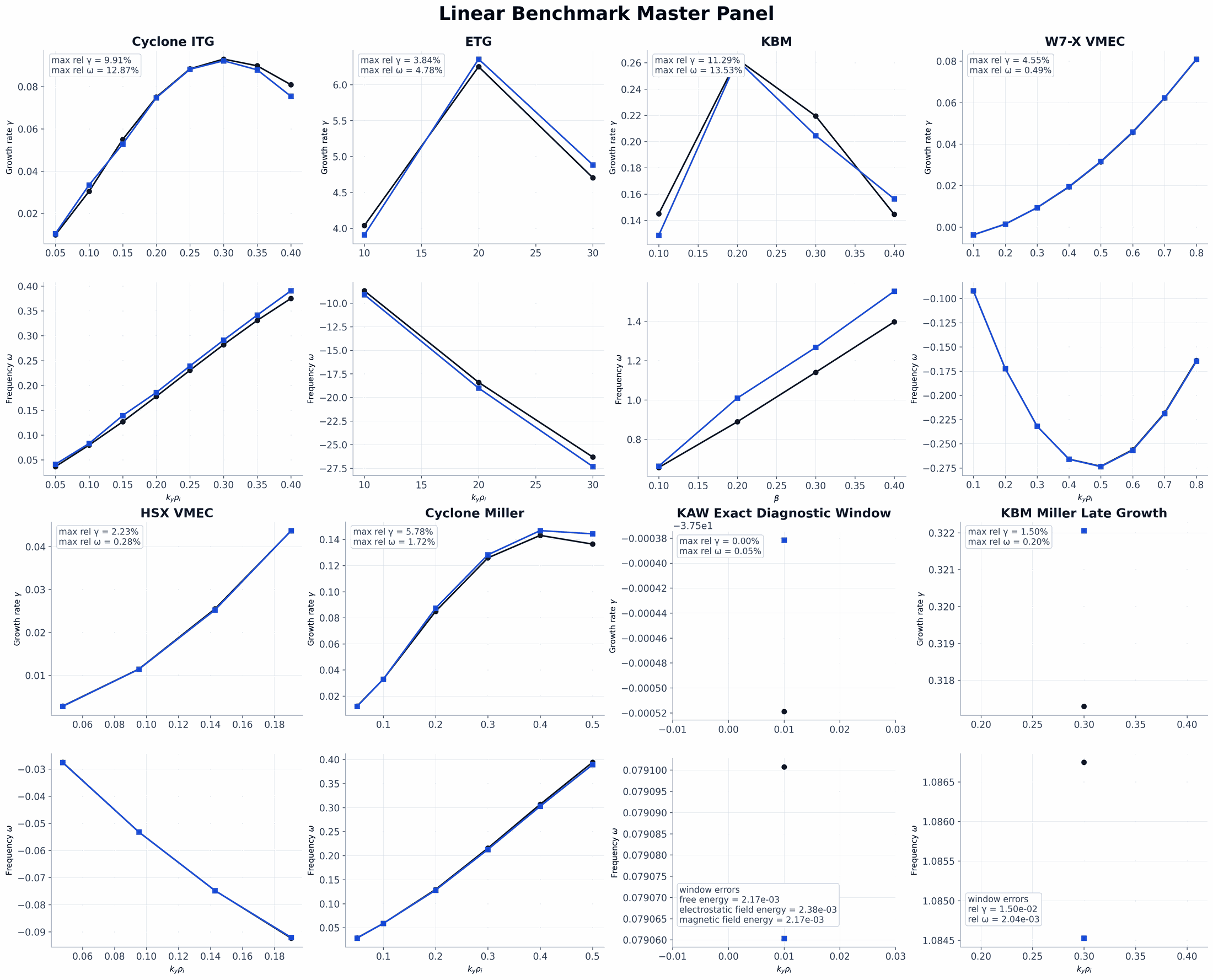
Linear benchmark master panel. This panel keeps the headline linear coverage on one page: Cyclone ITG, ETG, KBM, W7-X, HSX, Cyclone Miller, KAW, and the KBM Miller late-growth replay.
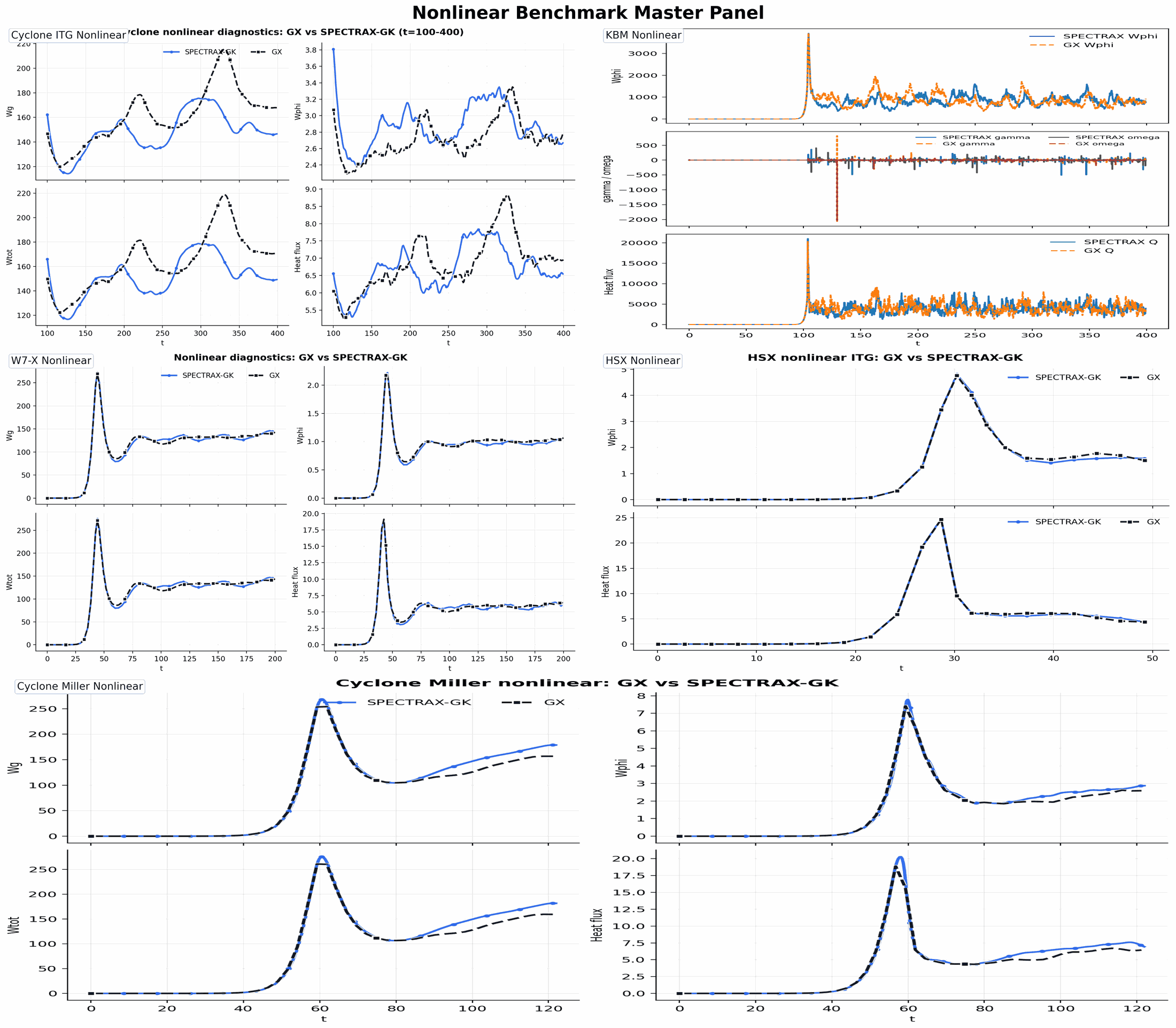
Nonlinear benchmark master panel. This panel groups the tracked nonlinear overlays used in the public benchmark set: Cyclone, KBM, W7-X, HSX, and Cyclone Miller.
For the current release pass, Cyclone, KBM, W7-X, HSX, and Cyclone Miller are treated as the acceptable nonlinear validation set in the main atlas. The short-window full-GK ETG pilot remains documented in the examples and testing notes, but it is intentionally kept out of the primary publication panel because it is a pilot rather than a headline transport benchmark. TEM and KAW are intentionally kept out of the active parity claim until their separate recovery work is finished.
The global release claim boundary is summarized in Release Scope and Claim Boundaries. Use that page when deciding whether a benchmark panel supports a README, release note, or manuscript claim.
Interpretation of validation
The atlas intentionally mixes two classes of evidence:
broad benchmark overlays over scanned parameters such as
k_yorbeta,exact-window or exact-diagnostic closures on selected lanes.
Only the exact-window closures should be read as strict small-tolerance validation gates. In the current tracked set those are:
KAW exact diagnostic window
KBM Miller late-growth replay
The broader scanned benchmark panels are coverage figures, not universal
rtol <= 3e-2 claims for every tile. They remain valuable because they show
which branches and diagnostics are being tracked across the codebase.
Benchmark-specific replay knobs used to regenerate these figures stay confined
to the benchmark builders in tools/. They are not promoted into generic
runtime defaults for the solver or the shipped example drivers.
Benchmark runner internals
spectraxgk.benchmarks is a compact reference-policy facade. Reusable
reference loaders and comparison policies live in
spectraxgk.benchmarking.shared; timestepping, scans, geometry, and physical
operators use the same runtime and solver APIs as ordinary simulations.
Case-level reproduction policy stays in root benchmarks/ drivers rather
than creating a second installed solver stack.
Generic pointwise scans and representative-mode extraction are owned by
spectraxgk.workflows.linear. They deliberately call one linear solve per
k_y and accept optional resolution and Krylov policies. Benchmark drivers
provide case policy; the reusable workflow owns iteration, result assembly,
mode selection, and fit-window extraction. The former scan_fn argument was
removed because it was accepted but never used.
For the current stellarator nonlinear pair, the tracked public figures should also be read asymmetrically:
HSX nonlinear is currently acceptable on the best validated
t <= 50trace and remains part of the public benchmark set.W7-X nonlinear is currently acceptable on the refreshed
t <= 200trace and remains part of the public benchmark set. It should still be read as a long-window benchmark closure rather than a universal small-tolerance claim for every late-time sample.
README summary panel
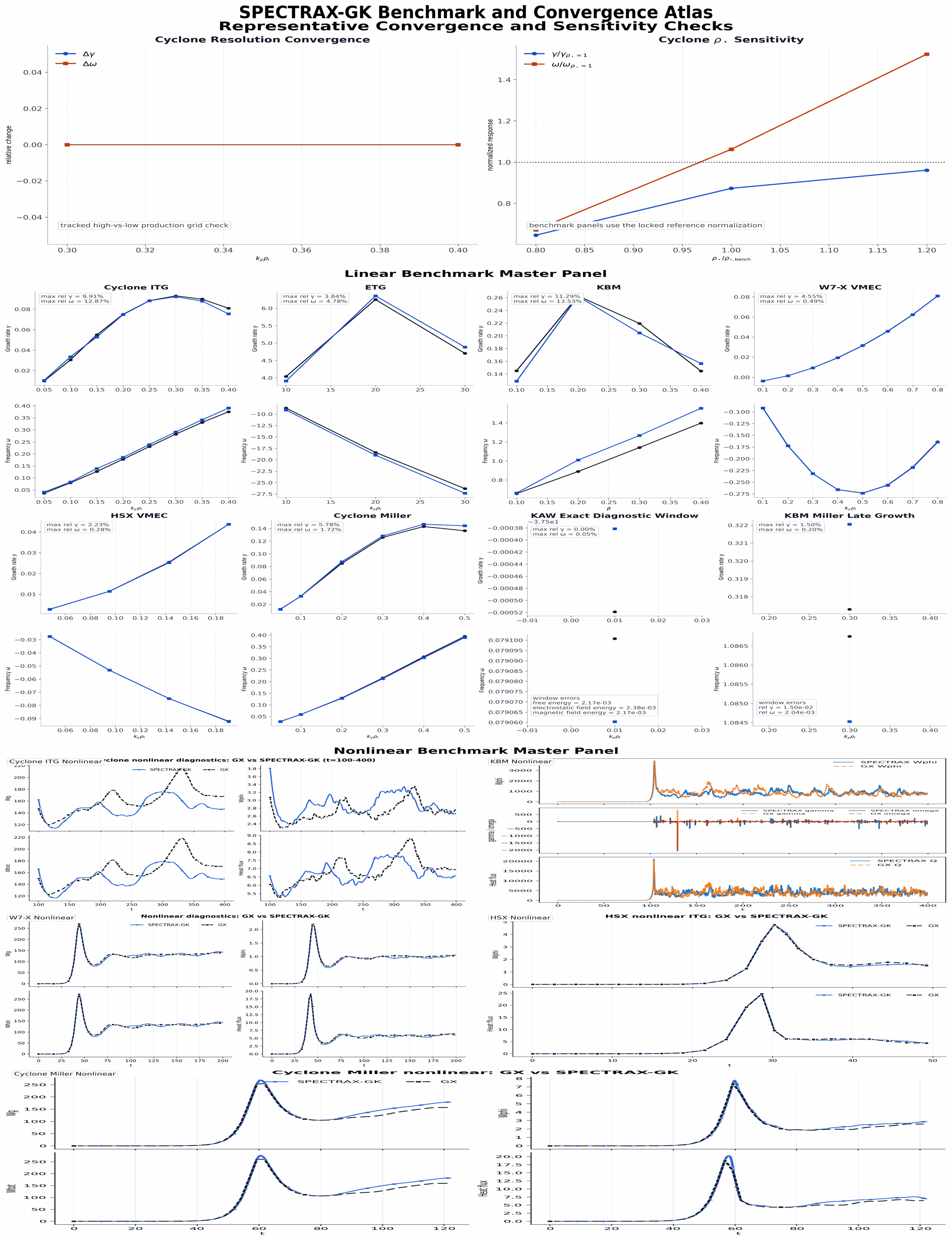
Publication-facing benchmark summary. The shipped summary/publication stack now includes the closed short-window full-GK ETG nonlinear pilot alongside the tokamak and stellarator headline lanes, while the top-level README atlas remains compact with one validation image and one separate runtime/memory image.
Supplementary closure figures
Some parity lanes are tracked as supplementary closure artifacts rather than as headline atlas tiles. Current examples include:
docs/_static/nonlinear_cyclone_short_resolved_audit_t5.pngfor the corrected short nonlinear Cyclone replay, which now uses the explicit short-reference dissipation contract and localizes the remaining mismatch in resolvedk_yfield-energy diagnostics.docs/_static/comparison/secondary_reference_out_compare.csvfor the refreshed secondary stage-2 mode table built from the densekh01aGX replay.docs/_static/nonlinear_w7x_diag_compare_t200.png,docs/_static/hsx_nonlinear_compare_t50_true.png, anddocs/_static/nonlinear_kbm_diag_compare_t100_refresh.pngfor the refreshed long-window nonlinear publication figures.docs/_static/etg_fullgk_pilot_compare_dt1e4_gaussian_match.pngfor the closed short-window full-GK ETG nonlinear pilot that now appears in the shipped summary/publication panels.docs/_static/kbm_eigenfunction_overlap_summary.pngfor the current eigenfunction-overlap summary on the tracked KBM GX candidate table. This is the first compact overlap artifact in the manuscript-facing stack and should be read as a branch-identity diagnostic. The raw mode-shape overlays are now tracked separately asdocs/_static/kbm_eigenfunction_reference_overlay_ky0p3000.pnganddocs/_static/w7x_eigenfunction_reference_overlay_ky0p3000.pngwith JSON gate reports underdocs/_static/reference_modes/.
Extended stress matrix
Not every benchmark lane belongs in the headline validation claim. The extended linear stress matrix keeps exploratory or still-evolving lanes visible without mixing them into the primary publication set.
The current extended panel covers:
Cyclone kinetic electrons
TEM (literature-backed stress lane)
KBM Miller exact late growth window
The kinetic-electron scan is defined by
examples/linear/axisymmetric/runtime_kinetic_electron.toml and runs through
the unified runtime API. Its effective reference seed, linked-boundary damping,
species, and electromagnetic toggles are explicit in that file rather than
being applied by a hidden benchmark wrapper.
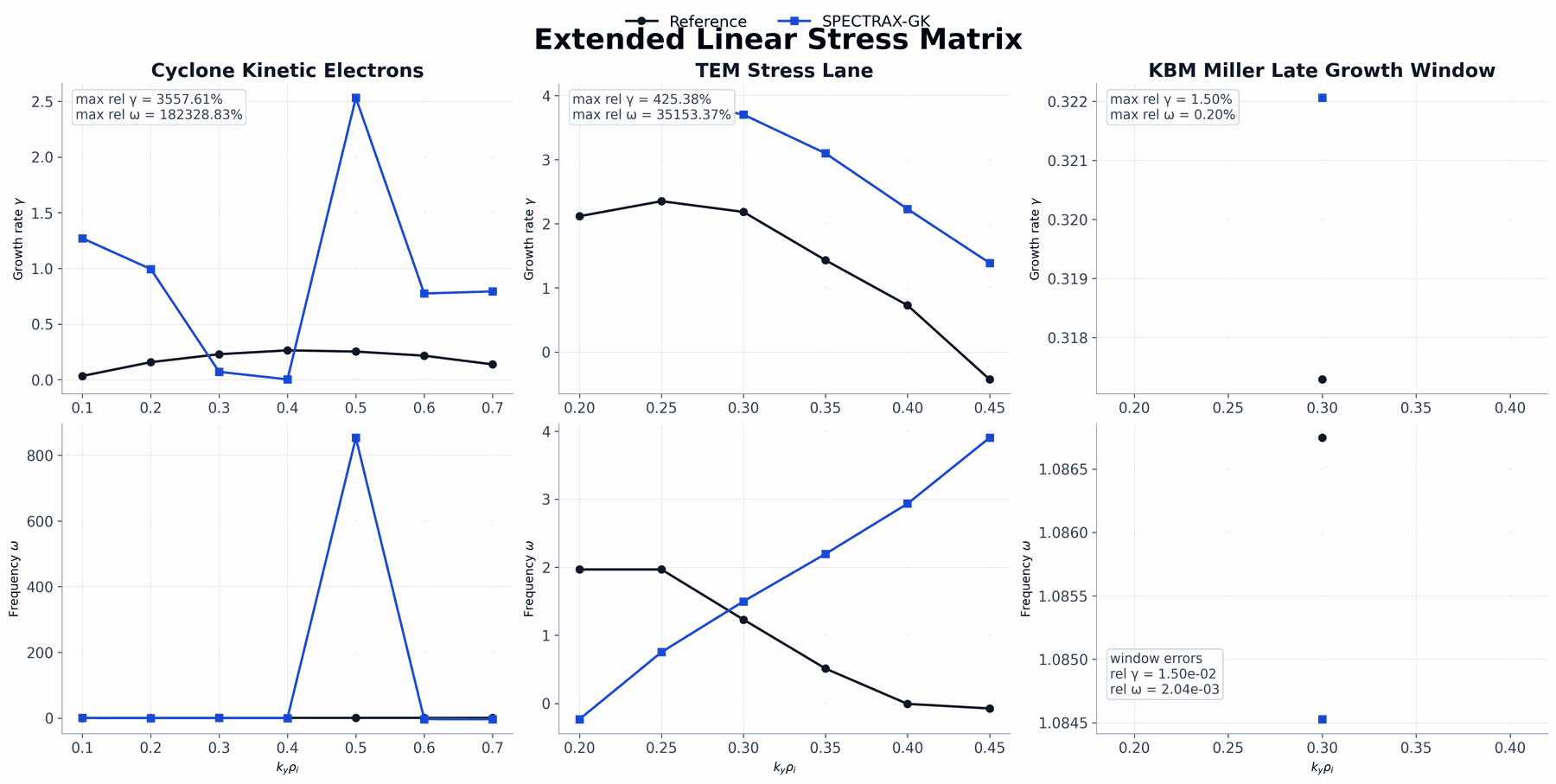
Extended linear stress matrix. These lanes remain visible for solver stress testing, but they are intentionally separated from the main publication panel.
The TEM row is provisional. The shipped tem_reference.csv is digitized from
the literature rather than sourced from a GX benchmark dump, and the exact case
definition behind that digitized curve is still being reassembled. It should be
read as a tracked stress lane, not as a closed parity result. The executable
audit docs/_static/tem_branch_parity_audit.{png,pdf,json,csv} records the
open branch mismatch explicitly: maximum absolute relative growth-rate
mismatch 4.25, maximum absolute relative frequency mismatch 3.3 after
excluding the near-zero reference denominator, one growth-rate sign mismatch,
three frequency sign mismatches, and a frequency-branch Spearman coefficient
near -0.986.
The authoritative executable input is
examples/linear/axisymmetric/runtime_tem.toml. It uses the unified runtime
schema, including electron-only Gaussian moment initialization, and
benchmarks/tem_linear_benchmark.py runs that file through the same runtime
scan path exposed to users. A state/parameter/RHS identity test protects the
migration from the former case-specific runner.
Case groups
Tokamak core cases
Cyclone ITG: linear
gamma/omegascans and nonlinear transport tracesKBM: linear branch-following scans and nonlinear transport traces
Cyclone Miller geometry: imported linear scan and nonlinear time-trace audit
Stellarator core cases
W7-X VMEC: short-window linear scans and nonlinear transport traces
HSX VMEC: short-window linear scans and nonlinear transport traces
Reduced and stress cases
ETG: linear benchmark overlays
KAW: exact late-time diagnostic reconstruction and exact-window energy audit
KBM Miller: exact late-time growth replay on the tracked low-
k_ybranchCyclone kinetic electrons: extended linear stress lane
TEM: extended linear stress lane
Notes on interpretation
The atlas is split deliberately. The README stays limited to a compact publication panel, while this page keeps the larger linear, nonlinear, and stress figures visible without claiming that every scanned point is an exact closure.